
Prawn crackers
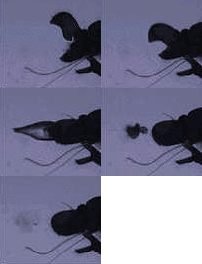
The noise of snapping shrimps slamming their claws shut isn't what it seems, according to researchers in the Netherlands.
It's long been known that the snapping shrimp is the noisiest creature in the shallow ocean, so loud that it seriously interferes with submarine sonar. The shrimp uses the snapping noise to stun its prey. The noise is produced when the shrimp's snapper claw slams shut, and it had previously been assumed that it was made simply by the two parts of the claw striking against each other.
However, four researchers from Germany and the Netherlands have found that, in fact, the noise is produced a short time after the claw shuts. They have shown that it is the result of the popping of bubbles created as water is forced out from the claw at high speed, a process known as "cavitation".
Cavitation is a consequence of Bernoulli's law, described in Daniel Bermoulli and the making of the fluid equation in issue 1 of Plus. Bernoulli's law insists that as the velocity of a fluid increases, its pressure decreases. As the snapping shrimp's claw shuts, it expels a jet of water at high speed. The pressure in this jet drops so low that the water vaporises, and creates a bubble of water vapour. The bubble is called a cavitation bubble.
Of course the bubble soon slows down and its vapour pressure cannot withstand the pressure of the surrounding water, so the bubble shrinks and disappears as the vapour turns back to the liquid state. It is the "popping" and disappearing of the cavitation bubble that causes the loud snapping noise from which snapping shrimps take their name.
Cavitation was first discovered in 1916 by the physicist Lord Rayleigh, who was investigating damage to ships' propellers. It turned out that this was due to cavitation bubbles caused by the speed of the propellers. When a bubble collapses, it does so asymmetrically, often creating a small jet of liquid. It was these jets that were causing the damage.
In the late 1950s, the collapse of a cavitation bubble became one of the first problems in applied mathematics to be studied seriously using a computer. For the new research on snapping shrimps, the German and Dutch scientists described the cavitation bubbles in terms of a "Rayleigh-Plesset type" equation, based on the equations that Rayleigh developed.