
The decimal number system was introduced to Europe nearly 800 years ago and is a vast improvement on the previous system of Roman numerals (see "The life and numbers of Fibonacci" elsewhere in this issue). But good though it is, the decimal number system cannot represent all numbers exactly.
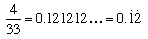
Although sums like 4 divided by 33 result in values with an infinite number of digits to the right of the decimal point, they always have repeating patterns. We can use special dots placed above the digits to show this.
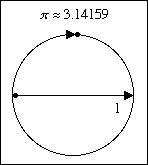
Numbers like Pi, on the other hand, have no repeating pattern. So just how accurately do we know what it is? To find out you might like to talk to Yasumasa Kanada and his colleagues at the University of Tokyo. They have recently broken the world record for calculating the most accurate approximation using a Hitachi supercomputer. The Japanese researches have calculated 50 billion decimal digits of Pi, that's about 10 digits for every person in the world today.
So if this sequence of digits contains no repeating pattern does that mean it's completely random? It depends who you ask. Mathematicians have been grappling with the idea of just what makes a random sequence for decades. A simple way of measuring randomness could have applications in a wide range of fields from the analysis of the stock market to the prevention of sudden infant death syndrome.