
News story
Article

No place like home for Martin Rees
Astronomer Royal Sir Martin Rees gives Plus a whistlestop tour of some of the more extraordinary features of our cosmos, and explains how lucky we are that the universe is the way it is.
News story
Article
Mathematical mysteries: Strange Geometries
The famous mathematician Euclid is credited with being the first person to axiomatise the geometry of the world we live in - that is, to describe the geometric rules which govern it. Based on these axioms, he proved theorems - some of the earliest uses of proof in the history of mathematics.
Article
Looking at life with Gerardus 't Hooft
Nobel Prizewinning Physicist Professor Gerardus 't Hooft has always been fascinated by the mathematical mysteries of nature. He tells Plus about his early life, and what our Universe might really be like.
News story
Happy Birthday Stephen Hawking!
This issue of Plus is a special, marking the occasion of Stephen Hawking's 60th birthday. Plus attended his Birthday Conference in Cambridge, where we interviewed some of the world's most influential mathematicians and physicists.
Article

Mathematical mysteries: Survival of the nicest?
One of the most puzzling aspects of human behaviour is cooperation, in situations where backstabbing and selfishness would seem to be more rewarding. From the point of view of evolutionary theory, the very existence of altruism and cooperation appear mysterious.
Article
Catching waves with Kip Thorne
What happens when one black hole meets another? Professor Kip Thorne shows us how to eavesdrop on these cosmic events by watching for telltale gravitational waves.
Article
Why knot: knots, molecules and stick numbers
Knots crop up all over the place, from tying a shoelace to molecular structure, but they are also elegant mathematical objects. Colin Adams asks when is a molecule knot a molecule? and what happens if you try to build a knot out of sticks?
Article
How big is the Milky Way?
A question which has been vexing astronomers for a long time is whether the forces of attraction between stars and galaxies will eventually result in the universe collapsing back into a single point, or whether it will expand forever with the distances between stars and galaxies growing ever larger. Toby O'Neil describes how the mathematical theory of dimension gives us a way of approaching the question.
Article
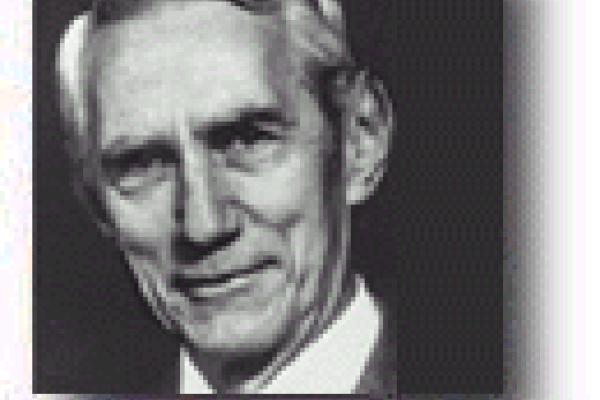
RIP Claude Shannon
Claude Shannon, who died on February 24, was the founder of Information Theory, which is the basis of modern telecommunications. Rachel Thomas looks at Shannon's life and works.
News story