
Plus Magazine

Calculus is a collection of tools, such as differentiation and integration, for solving problems in mathematics which involve "rates of change" and "areas". In the first of two articles aimed specially at students meeting calculus for the first time, Chris Sangwin tells us about these tools - without doubt, the some of the most important in all of mathematics.
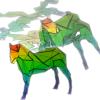
Not only are paper models of geometric shapes beautiful and intriguing, but they also allow us to visualise and understand some important geometric constructions. Konrad Polthier tells us about the gentle art of paper folding.

Combinatorial Game Theory is a powerful tool for analysing mathematical games. Lewis Dartnell explains how the technique can be used to analyse games such as Twentyone and Nim, and even some chess endgames.

Marcus du Sautoy begins a two part exploration of the greatest unsolved problem of mathematics: The Riemann Hypothesis. In the first part, we find out how the German mathematician Gauss, aged only 15, discovered the dice that Nature used to chose the primes.

Skot McDonald talks to Plus about how he uses mathematics to understand music, and how he managed to combine his passions for music and computing to create a successful career.