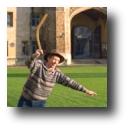
Are you interested in boomerangs? In this issue we explain how to make your own boomerang at look at some of the physics that make boomerangs work. Is a boomerang really a kind of gyroscope? And what are gyroscopes? Besides, we look at the history of mathematical proof.
Issue 7
|
Starting in this issue, PASS Maths is pleased to present a series of articles about proof and logical reasoning. In this article we give a brief introduction to deductive reasoning and take a look at one of the earliest known examples of mathematical proof.
|
If boomerangs are really gyroscopes, then what are gyroscopes? In this article, we explore some more of the physics of gyroscopes, and demonstrate some interesting experiments you can do with them.
|
|
Whatever is so wonderful about point B that makes all the people at point A want to get there? Robert Hunt sits at point C, and muses on the problem.
|
In this article, we look at the physics behind the curved flight path of a returning boomerang, and explain that boomerangs are really a kind of gyroscope. We even show you how to bang up a boomerang yourself!
|
|
Here's how you can make your own cross-shaped boomerang - and it's safe enough to fly indoors! Hugh rolls up his sleeves and proves that theory isn't everything.
|
Bisecting a given angle using only a pair of compasses and a straight edge is easy. But trisecting it - dividing it into three equal angles - is in most cases impossible. Why? |
|
Andrew Wensley works at Eidos Interactive, the company who publish the mega-successful computer game Tomb Raider, featuring 90s icon Lara Croft. Andrew is a long-term computer game fan with an academic background in maths. PASS Maths caught up with him at Eidos's Wimbledon offices.
|
|