
Home
plus.maths.org

Secondary menu

  • My list
  • About Plus
  • Sponsors
  • Subscribe
  • Contact Us
  • Log in
  • Main navigation

  • Home
  • Articles
  • Collections
  • Podcasts
  • Maths in a minute
  • Puzzles
  • Videos
  • Topics and tags
  • For

    • cat icon
      Curiosity
    • newspaper icon
      Media
    • graduation icon
      Education
    • briefcase icon
      Policy

    Popular topics and tags

    Shapes

    • Geometry
    • Vectors and matrices
    • Topology
    • Networks and graph theory
    • Fractals

    Numbers

    • Number theory
    • Arithmetic
    • Prime numbers
    • Fermat's last theorem
    • Cryptography

    Computing and information

    • Quantum computing
    • Complexity
    • Information theory
    • Artificial intelligence and machine learning
    • Algorithm

    Data and probability

    • Statistics
    • Probability and uncertainty
    • Randomness

    Abstract structures

    • Symmetry
    • Algebra and group theory
    • Vectors and matrices

    Physics

    • Fluid dynamics
    • Quantum physics
    • General relativity, gravity and black holes
    • Entropy and thermodynamics
    • String theory and quantum gravity

    Arts, humanities and sport

    • History and philosophy of mathematics
    • Art and Music
    • Language
    • Sport

    Logic, proof and strategy

    • Logic
    • Proof
    • Game theory

    Calculus and analysis

    • Differential equations
    • Calculus

    Towards applications

    • Mathematical modelling
    • Dynamical systems and Chaos

    Applications

    • Medicine and health
    • Epidemiology
    • Biology
    • Economics and finance
    • Engineering and architecture
    • Weather forecasting
    • Climate change

    Understanding of mathematics

    • Public understanding of mathematics
    • Education

    Get your maths quickly

    • Maths in a minute

    Main menu

  • Home
  • Articles
  • Collections
  • Podcasts
  • Maths in a minute
  • Puzzles
  • Videos
  • Topics and tags
  • Audiences

    • cat icon
      Curiosity
    • newspaper icon
      Media
    • graduation icon
      Education
    • briefcase icon
      Policy

    Secondary menu

  • My list
  • About Plus
  • Sponsors
  • Subscribe
  • Contact Us
  • Log in
  • 'How to lie with statistics'
    1 May, 2004
    May 2004
    (none)

    How to lie with statistics

    By Darrell Huff

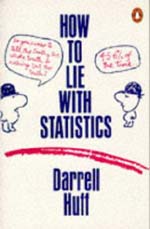
    Although this book is 50 years old this year, its wisdom is needed now more than ever, as increasing computer power and our headline-obsessed media look set to drown us all in a sea of "statisticulation". This is the word coined by Darrell Huff to describe misinformation by the use of statistical material. Biased samples, dubious graphs, semi-attached figures: he describes all the usual suspects clearly and simply, rounding off with the most useful topic of all: How to Talk Back to a Statistic.

    Here Huff explains "how to look a phoney statistic in the eye and face it down; and no less important, how to recognize sound and usable data in [the] wilderness of fraud". Look for bias, he advises, conscious and unconscious; find out "who-says-so" (if an "O.K. name" is cited, make sure it stands behind the information, not merely beside it); ask how the authority knows; try to find out what's missing; check whether the raw figure justifies the conclusion drawn and, most straightforwardly of all, ask yourself if the statistic makes sense.

    The very final example of the book concerns trends. If you know how something is changing over some short time period, you can make the situation seem much more extreme by projecting the trend into the future and coming up with some headline-grabbing prediction. An increase of, say, a percent in the rate of some disease over the last ten years can be converted into an epidemic of biblical proportions if you just predict that the trend continues unchanged for long enough. Of course, there may be no particular reason to believe that the trend will continue, but in the meantime, you have got your headline and the media have their scare story (see Editorial trends in this issue of Plus for a current example).

    "How to lie with statistics" is entertainingly illustrated with original cartoons, and written in a clear and easy style (Huff was a professional author who had done postgraduate work in statistics, rather than a professional statistician trying to preach to the non-numerate). It is short - 128 pages and that includes illustrations - so you can easily read it at a single sitting. And it could be one of the most valuable investments of £6.39 (from Amazon UK) and two hours of your time you will ever make.

    Book details:
    How to lie with statistics
    Darrell Huff
    paperback - 128 pages (1991; first printed 1954)
    Penguin Business
    ISBN: 0140136290
    Buy it from Amazon UK

    About the reviewer

    Helen Joyce is editor of Plus.

    • Log in or register to post comments

    Read more about...

    book review
    University of Cambridge logo

    Plus is part of the family of activities in the Millennium Mathematics Project.
    Copyright © 1997 - 2025. University of Cambridge. All rights reserved.

    Terms