
'The Cogwheel Brain'
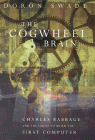
The Cogwheel Brain: Charles Babbage and the quest to build the first computer
by Doron SwadeReviewed by Helen Joyce
I wish to God these calculations had been executed by steam."
With these words, spoken in 1821, Charles Babbage embarked on the great quest of his life - the attempt to fully automate calculation. Goaded by the all-pervasive errors in the tables of the period, he began to conceive of a great machine that would replace human fallibility with utter mechanical reliability.
Despite dedicating decades of his life and large sums of money to the quest, Babbage never succeeded in realising his vision. In fact, for a long time the consensus was that the engineering standards of the time were too low to permit Babbage's machines to be built, and that anyway most likely the designs were flawed. The world had to wait until 1991 - the bicentenary of Babbage's birth - before Babbage was finally vindicated. In that year, the Science Museum in London completed the first full-size Difference Engine No. 2, using materials and engineering tolerances authentic to Babbage's era.
The earlier part of "The Cogwheel Brain" is dedicated to Babbage's life and his attempts to build, first, a Difference Engine, intended to automate the use of the method of finite differences to calculate table values; and second, the vastly more ambitious Analytical Engine, in essence the world's first programmable computer. The later part describes the genesis and completion of the Science Museum's project to build the Difference Engine No. 2.
Doron Swade, for a long time curator of computing at the Science Museum, and now its assistant director and head of collections, is in a strong position to chronicle the Science Museum project, and describes the pitfalls and difficulties in detail - possibly on occasion too much detail. For this reader, the descriptions of the problems of raising funding and hiring contractors dragged - although the catalogue of engineering and manufacturing hitches did underline the difficulties faced by Babbage in his lifetime.
The picture drawn here of Babbage, as a person and an inventor, is sympathetic and detailed. Interestingly, Doron Swade disagrees with the often-quoted theory that Babbage had a significant effect on modern digital computing. And although Swade is sympathetic to the situation and aspirations of Ada Lovelace, daughter of Byron, who translated and annotated a paper describing the Analytical Engine, he is very clear that the widespead modern conception of her as a serious collaborator on Babbage's work is incorrect.
The Science Museum completed a printer for its Difference Engine in April 2000, (see Issue 11 of Plus). This book about the life and works of one of the most inventive figures of British mathematics will hopefully prompt many readers to visit to the Science Museum to see the modern incarnation of the engine, plus printer, in all its glory.
- Book details:
- The Cogwheel Brain: Charles Babbage and the quest to build the first computer
- Doron Swade
- Hardback - 342 pages (2000)
- Little, Brown and Company
- Hardcover ISBN: 0 316 64847 7