
'Euclid's Window'
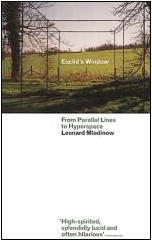
Euclid's Window: The Story of Geometry from Parallel Lines to Hyperspace
By Leonard Mlodinow
Anyone who thought geometry was boring or dry should prepare to be amazed. Despite its worthy cover this book is exactly what its title says - a story - and the plot of this story involves life, death and revolutions of understanding and belief, and stars the some of the most famous names in history.
The book opens with Aristotle watching ships at sea disappearing hull first over the horizon. "On a flat earth, ships should dwindle evenly until they disappear", and so he came to the realisation that the earth must be curved. This sets the scene for Mlodinow's tale of how geometry has shaped human history - "to observe the large scale structure of our planet, Aristotle had looked through the window of geometry." The book recounts how we have continued to look through this window to understand the reality we live in, and how the window has changed along the way.
The book is arranged as a series of five tales of the "five geometric revolutions of world history". These are told as the story of their main figures - Euclid, Descartes, Gauss, Einstein and Witten - in the context of their time, place and culture. This is one of the things that makes this book stand apart from others on the history of mathematics and science. It is told as a series of personal stories, of discoveries and leaps of understanding made by human beings. And this perhaps unexpectedly human side of geometry is enhanced by Mlodinow's accessible style. He is able to bring historical situations and mathematical concepts to life with the language of the present day. For example he explains the importance of applied geometry to Egyptians: "In building a pyramid, just a degree off from true, and thousands of tons of rocks, thousands of person-years later, hundreds of feet in the air, the triangular faces of your pyramid miss, forming not an apex by a sloppy four pointed spike. The Pharaohs, worshipped as gods, with armies who cut the phalluses off enemy dead just to help them keep count, were not the kind of all-powerful deities you would want to present with a crooked pyramid."
This book also contains some of the clearest explanations of relativity and string theory that I have ever read. Placed in the context of the evolution of geometry, and told as human triumphs of discovery by Einstein and Witten and their peers, these theories offer answers to obvious questions arising from our struggle to understand our reality. They also contain some very amusing examples such as Mlodinow explaining the entropy of black holes in terms of the messiness of his son, Alexei's bedroom. "Before Hawking, black holes, thought to have no internal structure, were thought to be something like an empty room. But now it seems they are like Alexei's actual room. Had Hawking asked, I could have confirmed this: I have always told Alexei that his room was like a black hole."
This is an excellent book not just for those select few fascinated by geometry, but for anyone interested in history of science, philosophy and humanity. In fact I would recommend it to anyone who enjoys a good story. Who would have thought that the story of geometry would include tales of life, death, sex and taxes?
- Book details:
- Euclid's Window: The Story of Geometry from Parallel Lines to Hyperspace
- Leonard Mlodinow
- hardback - 320 pages (2002)
- Allen Lane The Penguin Press
- ISBN: 071399634X