Home
plus.maths.org

Secondary menu

  • My list
  • About Plus
  • Sponsors
  • Subscribe
  • Contact Us
  • Log in
  • Main navigation

  • Home
  • Articles
  • Collections
  • Podcasts
  • Maths in a minute
  • Puzzles
  • Videos
  • Topics and tags
  • For

    • cat icon
      Curiosity
    • newspaper icon
      Media
    • graduation icon
      Education
    • briefcase icon
      Policy

    Popular topics and tags

    Shapes

    • Geometry
    • Vectors and matrices
    • Topology
    • Networks and graph theory
    • Fractals

    Numbers

    • Number theory
    • Arithmetic
    • Prime numbers
    • Fermat's last theorem
    • Cryptography

    Computing and information

    • Quantum computing
    • Complexity
    • Information theory
    • Artificial intelligence and machine learning
    • Algorithm

    Data and probability

    • Statistics
    • Probability and uncertainty
    • Randomness

    Abstract structures

    • Symmetry
    • Algebra and group theory
    • Vectors and matrices

    Physics

    • Fluid dynamics
    • Quantum physics
    • General relativity, gravity and black holes
    • Entropy and thermodynamics
    • String theory and quantum gravity

    Arts, humanities and sport

    • History and philosophy of mathematics
    • Art and Music
    • Language
    • Sport

    Logic, proof and strategy

    • Logic
    • Proof
    • Game theory

    Calculus and analysis

    • Differential equations
    • Calculus

    Towards applications

    • Mathematical modelling
    • Dynamical systems and Chaos

    Applications

    • Medicine and health
    • Epidemiology
    • Biology
    • Economics and finance
    • Engineering and architecture
    • Weather forecasting
    • Climate change

    Understanding of mathematics

    • Public understanding of mathematics
    • Education

    Get your maths quickly

    • Maths in a minute

    Main menu

  • Home
  • Articles
  • Collections
  • Podcasts
  • Maths in a minute
  • Puzzles
  • Videos
  • Topics and tags
  • Audiences

    • cat icon
      Curiosity
    • newspaper icon
      Media
    • graduation icon
      Education
    • briefcase icon
      Policy

    Secondary menu

  • My list
  • About Plus
  • Sponsors
  • Subscribe
  • Contact Us
  • Log in
  • Find out about the applications of origami — Maths-Art seminar on 9 June
    26 May, 2011
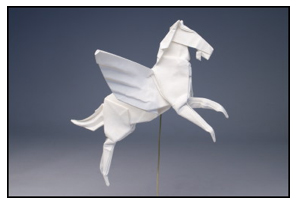
    <i>Pegasus</i> made by Robert J. Lang from one uncut square of Korean hanji paper. Image courtesy <a href='http://www.langorigami.com'> Robert J. Lang</a>.

    Pegasus made by Robert J. Lang from one uncut square of Korean hanji paper. Size: 7 inches. Image courtesy Robert J. Lang.

    If you've ever marvelled at the elegance of a paper crane or just struggled to refold a map you will enjoy the next Maths-Art seminar from the London Knowledge Lab.

    Applications of Origami will be a practical, hands-on workshop and presentation by Mark Bolitho and members of the British Origami Society. The presentation will cover recent developments in origami and present some of the projects Mark has worked on. It will also review how origami techniques have been adopted in applied design from architecture to product design.

    DATE: Thursday 9th June
    TIME: 5.00 to 7.30pm
    PLACE: London Knowledge Lab, 23-29 Emerald St, London, WC1N 3QS

    The Maths-Art seminars are free to attend and everyone welcome. You don't need a reservation but an email to lkl.maths.art@gmail.com is appreciated for planning purposes. You can also watch past Maths-Art seminars on YouTube and read more about the maths of origami on Plus.

    • Log in or register to post comments
    University of Cambridge logo

    Plus is part of the family of activities in the Millennium Mathematics Project.
    Copyright © 1997 - 2025. University of Cambridge. All rights reserved.

    Terms