Home
plus.maths.org

Secondary menu

  • My list
  • About Plus
  • Sponsors
  • Subscribe
  • Contact Us
  • Log in
  • Main navigation

  • Home
  • Articles
  • Collections
  • Podcasts
  • Maths in a minute
  • Puzzles
  • Videos
  • Topics and tags
  • For

    • cat icon
      Curiosity
    • newspaper icon
      Media
    • graduation icon
      Education
    • briefcase icon
      Policy

    Popular topics and tags

    Shapes

    • Geometry
    • Vectors and matrices
    • Topology
    • Networks and graph theory
    • Fractals

    Numbers

    • Number theory
    • Arithmetic
    • Prime numbers
    • Fermat's last theorem
    • Cryptography

    Computing and information

    • Quantum computing
    • Complexity
    • Information theory
    • Artificial intelligence and machine learning
    • Algorithm

    Data and probability

    • Statistics
    • Probability and uncertainty
    • Randomness

    Abstract structures

    • Symmetry
    • Algebra and group theory
    • Vectors and matrices

    Physics

    • Fluid dynamics
    • Quantum physics
    • General relativity, gravity and black holes
    • Entropy and thermodynamics
    • String theory and quantum gravity

    Arts, humanities and sport

    • History and philosophy of mathematics
    • Art and Music
    • Language
    • Sport

    Logic, proof and strategy

    • Logic
    • Proof
    • Game theory

    Calculus and analysis

    • Differential equations
    • Calculus

    Towards applications

    • Mathematical modelling
    • Dynamical systems and Chaos

    Applications

    • Medicine and health
    • Epidemiology
    • Biology
    • Economics and finance
    • Engineering and architecture
    • Weather forecasting
    • Climate change

    Understanding of mathematics

    • Public understanding of mathematics
    • Education

    Get your maths quickly

    • Maths in a minute

    Main menu

  • Home
  • Articles
  • Collections
  • Podcasts
  • Maths in a minute
  • Puzzles
  • Videos
  • Topics and tags
  • Audiences

    • cat icon
      Curiosity
    • newspaper icon
      Media
    • graduation icon
      Education
    • briefcase icon
      Policy

    Secondary menu

  • My list
  • About Plus
  • Sponsors
  • Subscribe
  • Contact Us
  • Log in
  • 'The Golden Section'
    1 December, 2000
    Nov 2001

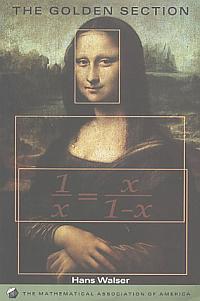
    The Golden Section

    Hans Walser, trans. Peter Hilton

    Mathematical Association of America 2001

    The golden section (or golden ratio), famously, was used in antiquity, when the ancient Greeks built temples the proportions of whose parts - by accident or design - are often supposed to have fallen in the golden ratio. In this little book, Hans Walser is concerned with the mathematical properties of self-similarity which presumably give this particular ratio its aesthetic appeal. It therefore fills a gap felt by those who have read about the number's supposed mystical properties but would like a more solid introduction to its mathematical ones. The maths is reasonably brisk, so the book will mainly appeal to readers who have, or are studying, maths at A-level, or at least are not afraid of plenty of equations.

    The book is divided into chapters on various areas (all more or less geometrical, with the exception of one on Number Sequences) where the golden section has hoisted its standard. It is a good mixture of exposition, questions to keep the reader alert, and pretty diagrams, which of course the subject invites. For example there is a chapter on fractals based on the golden section, and another on solid geometry. A pleasant feature is the frequent references back to earlier chapters, showing how different areas of mathematics interconnect.

    I have only one small complaint to record, and it concerns the production rather than the contents: the glossy cover is inclined to curl back in a peculiarly distressing way. (Yes, all paperbacks do this to an extent - but not to this extent.) If you can overlook that, this is a stimulating and diverting book.


    Book details:
    The Golden Section
    Hans Walser, Peter Hilton (Translator)
    Paperback - 158 pages (2001)
    The Mathematical Association of America
    ISBN 0883855348
    • Log in or register to post comments

    Read more about...

    book review
    University of Cambridge logo

    Plus is part of the family of activities in the Millennium Mathematics Project.
    Copyright © 1997 - 2025. University of Cambridge. All rights reserved.

    Terms