
Home
plus.maths.org

Secondary menu

  • My list
  • About Plus
  • Sponsors
  • Subscribe
  • Contact Us
  • Log in
  • Main navigation

  • Home
  • Articles
  • Collections
  • Podcasts
  • Maths in a minute
  • Puzzles
  • Videos
  • Topics and tags
  • For

    • cat icon
      Curiosity
    • newspaper icon
      Media
    • graduation icon
      Education
    • briefcase icon
      Policy

    Popular topics and tags

    Shapes

    • Geometry
    • Vectors and matrices
    • Topology
    • Networks and graph theory
    • Fractals

    Numbers

    • Number theory
    • Arithmetic
    • Prime numbers
    • Fermat's last theorem
    • Cryptography

    Computing and information

    • Quantum computing
    • Complexity
    • Information theory
    • Artificial intelligence and machine learning
    • Algorithm

    Data and probability

    • Statistics
    • Probability and uncertainty
    • Randomness

    Abstract structures

    • Symmetry
    • Algebra and group theory
    • Vectors and matrices

    Physics

    • Fluid dynamics
    • Quantum physics
    • General relativity, gravity and black holes
    • Entropy and thermodynamics
    • String theory and quantum gravity

    Arts, humanities and sport

    • History and philosophy of mathematics
    • Art and Music
    • Language
    • Sport

    Logic, proof and strategy

    • Logic
    • Proof
    • Game theory

    Calculus and analysis

    • Differential equations
    • Calculus

    Towards applications

    • Mathematical modelling
    • Dynamical systems and Chaos

    Applications

    • Medicine and health
    • Epidemiology
    • Biology
    • Economics and finance
    • Engineering and architecture
    • Weather forecasting
    • Climate change

    Understanding of mathematics

    • Public understanding of mathematics
    • Education

    Get your maths quickly

    • Maths in a minute

    Main menu

  • Home
  • Articles
  • Collections
  • Podcasts
  • Maths in a minute
  • Puzzles
  • Videos
  • Topics and tags
  • Audiences

    • cat icon
      Curiosity
    • newspaper icon
      Media
    • graduation icon
      Education
    • briefcase icon
      Policy

    Secondary menu

  • My list
  • About Plus
  • Sponsors
  • Subscribe
  • Contact Us
  • Log in
  • News from the world of maths: Mathematical physicist wins 2008 Templeton Prize

    25 March, 2008
    Tuesday, March 25, 2008

    Mathematical physicist wins 2008 Templeton Prize

    The 2008 Templeton Prize has been awarded to Polish mathematical physicist Michael Heller. Heller has worked for more than 40 years in theology, philosophy, mathematics and cosmology, and intends to use the £820,000 prize to set up a cross-university and inter-disciplinary institute to investigate questions in science, theology and philosophy.
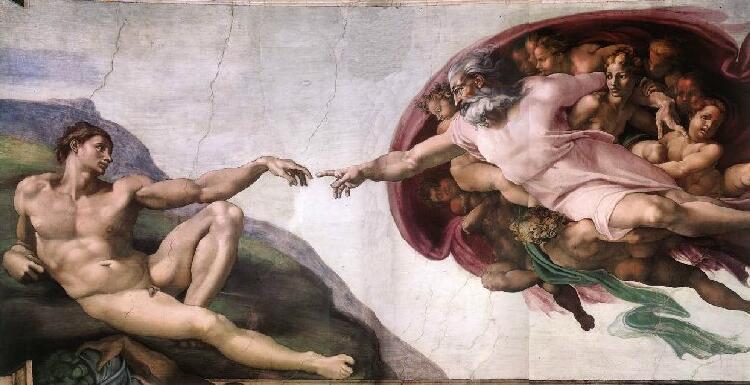
    16th century depiction of Genesis (Michelangelo, Sistine Chapel): God creates Adam. Like Galileo, Heller thinks that mathematics is the "language of God."

    The Templeton Prize was founded in 1972 by philanthropist Sir John Templeton, and is awarded annually to a living person for "progress toward research or discoveries about spiritual realities". It is the world's largest annual monetary prize of any kind given to an individual (£820,000). Plus reported on John Barrow's success in 2006.

    Heller has been rewarded for "developing sharply focused and strikingly original concepts on the origin and cause of the Universe, often under intense (communist Poland) governmental repression."

    Heller's work these days is largely in non-commutative geometry, which he uses to attempt to remove the problem of a cosmological singularity at the origin of the Universe. "If on the fundamental level of physics there is no space and no time, as many physicists think," says Heller, "non-commutative geometry could be a suitable tool to deal with such a situation."

    You can read more on non-commutative geometry in the Plus article Quantum Geometry.

    posted by westius @ 2:00 PM

    0 Comments:

    • Log in or register to post comments
    University of Cambridge logo

    Plus is part of the family of activities in the Millennium Mathematics Project.
    Copyright © 1997 - 2025. University of Cambridge. All rights reserved.

    Terms