
Home
plus.maths.org

Secondary menu

  • My list
  • About Plus
  • Sponsors
  • Subscribe
  • Contact Us
  • Log in
  • Main navigation

  • Home
  • Articles
  • Collections
  • Podcasts
  • Maths in a minute
  • Puzzles
  • Videos
  • Topics and tags
  • For

    • cat icon
      Curiosity
    • newspaper icon
      Media
    • graduation icon
      Education
    • briefcase icon
      Policy

    Popular topics and tags

    Shapes

    • Geometry
    • Vectors and matrices
    • Topology
    • Networks and graph theory
    • Fractals

    Numbers

    • Number theory
    • Arithmetic
    • Prime numbers
    • Fermat's last theorem
    • Cryptography

    Computing and information

    • Quantum computing
    • Complexity
    • Information theory
    • Artificial intelligence and machine learning
    • Algorithm

    Data and probability

    • Statistics
    • Probability and uncertainty
    • Randomness

    Abstract structures

    • Symmetry
    • Algebra and group theory
    • Vectors and matrices

    Physics

    • Fluid dynamics
    • Quantum physics
    • General relativity, gravity and black holes
    • Entropy and thermodynamics
    • String theory and quantum gravity

    Arts, humanities and sport

    • History and philosophy of mathematics
    • Art and Music
    • Language
    • Sport

    Logic, proof and strategy

    • Logic
    • Proof
    • Game theory

    Calculus and analysis

    • Differential equations
    • Calculus

    Towards applications

    • Mathematical modelling
    • Dynamical systems and Chaos

    Applications

    • Medicine and health
    • Epidemiology
    • Biology
    • Economics and finance
    • Engineering and architecture
    • Weather forecasting
    • Climate change

    Understanding of mathematics

    • Public understanding of mathematics
    • Education

    Get your maths quickly

    • Maths in a minute

    Main menu

  • Home
  • Articles
  • Collections
  • Podcasts
  • Maths in a minute
  • Puzzles
  • Videos
  • Topics and tags
  • Audiences

    • cat icon
      Curiosity
    • newspaper icon
      Media
    • graduation icon
      Education
    • briefcase icon
      Policy

    Secondary menu

  • My list
  • About Plus
  • Sponsors
  • Subscribe
  • Contact Us
  • Log in
  • Plus Advent Calendar Door #5: Five won't fit

    5 December, 2013

    Triangles do it, squares do it, even hexagons do it — but pentagons don't. They just won't fit together to tile your bathroom wall. That's the reason why you'll find it very difficult to find pentagonal tiles in any hardware shop.

    It's actually really easy to see why pentagons won't tile the plane. We are talking regular pentagons here, shapes that have five sides of equal length and angles between them. In a regular pentagon the internal angle between two sides is 108°. In a regular tiling, adjacent tiles share whole edges, rather than just parts of edges, so corners of tiles meet corners of other tiles. To fit a number of tiles around a corner point, their internal angles must add up to 360°, since that's a full turn. If you try to fit three pentagons, you only get 3 x 10⁸° = 324°, so there is a gap. If you fit four pentagons, you get 4 x 10⁸° = 432°, so two of them overlap. The same isn't true for equilateral triangles, squares, or regular hexagons. Here the internal angles are 60°, 90° and 120° respectively, so you can fit six triangles, four squares and three hexagons around a corner point. (You can try and work out for yourself if any other regular polygons can give you a regular tiling.)
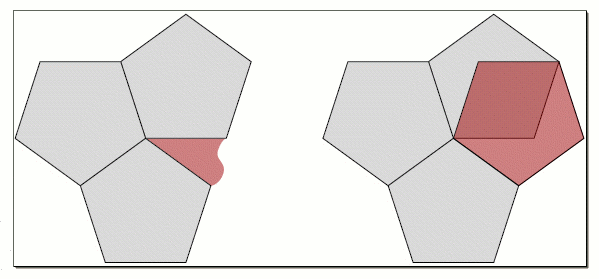
    Figure 2: Three pentagons arranged around a point leave a gap, and four overlap.

    Three pentagons arranged around a point leave a gap, and four overlap. Image: Craig Kaplan.

    If pentagons don't work can we perhaps use other shapes with five-fold symmetry to tile the plane? Find out more in The trouble with five.

    Return to the Plus Advent Calendar

    Read more about...
    Advent calendar 2013
    • Log in or register to post comments

    Read more about...

    Advent calendar 2013
    University of Cambridge logo

    Plus is part of the family of activities in the Millennium Mathematics Project.
    Copyright © 1997 - 2025. University of Cambridge. All rights reserved.

    Terms