
Home
plus.maths.org

Secondary menu

  • My list
  • About Plus
  • Sponsors
  • Subscribe
  • Contact Us
  • Log in
  • Main navigation

  • Home
  • Articles
  • Collections
  • Podcasts
  • Maths in a minute
  • Puzzles
  • Videos
  • Topics and tags
  • For

    • cat icon
      Curiosity
    • newspaper icon
      Media
    • graduation icon
      Education
    • briefcase icon
      Policy

    Popular topics and tags

    Shapes

    • Geometry
    • Vectors and matrices
    • Topology
    • Networks and graph theory
    • Fractals

    Numbers

    • Number theory
    • Arithmetic
    • Prime numbers
    • Fermat's last theorem
    • Cryptography

    Computing and information

    • Quantum computing
    • Complexity
    • Information theory
    • Artificial intelligence and machine learning
    • Algorithm

    Data and probability

    • Statistics
    • Probability and uncertainty
    • Randomness

    Abstract structures

    • Symmetry
    • Algebra and group theory
    • Vectors and matrices

    Physics

    • Fluid dynamics
    • Quantum physics
    • General relativity, gravity and black holes
    • Entropy and thermodynamics
    • String theory and quantum gravity

    Arts, humanities and sport

    • History and philosophy of mathematics
    • Art and Music
    • Language
    • Sport

    Logic, proof and strategy

    • Logic
    • Proof
    • Game theory

    Calculus and analysis

    • Differential equations
    • Calculus

    Towards applications

    • Mathematical modelling
    • Dynamical systems and Chaos

    Applications

    • Medicine and health
    • Epidemiology
    • Biology
    • Economics and finance
    • Engineering and architecture
    • Weather forecasting
    • Climate change

    Understanding of mathematics

    • Public understanding of mathematics
    • Education

    Get your maths quickly

    • Maths in a minute

    Main menu

  • Home
  • Articles
  • Collections
  • Podcasts
  • Maths in a minute
  • Puzzles
  • Videos
  • Topics and tags
  • Audiences

    • cat icon
      Curiosity
    • newspaper icon
      Media
    • graduation icon
      Education
    • briefcase icon
      Policy

    Secondary menu

  • My list
  • About Plus
  • Sponsors
  • Subscribe
  • Contact Us
  • Log in
  • Plus Advent Calendar Door #8: Monkeys play the peanut lottery
    8 December, 2019
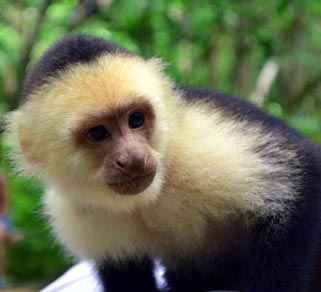
    A capuchin monkey.

    A capuchin monkey.

    Maths is useful for everyone, not just humans. To be successful in your hunting and foraging, and to keep track of your family members and predators, you need to be able to gauge quantities, which is why numerical ability developed early on in evolution. Many animals, including some fish and insects, use some sort of understanding of quantities to navigate their lives.

    That's a very basic type of maths, but what about something a little more sophisticated, such as, for example, probabilities? A 2017 study with capuchin monkeys addressed this question, and seems to suggest that, at least some of them, have an intuitive grasp of chances.

    The study involved researchers appearing to randomly pick a treat from a jar which contained a mixture of tasty peanuts and not-as-tasty monkey pellets, in full view of a hungry monkey. The researcher would conceal the treat in one hand, and use the other hand to pick another treat from a different jar containing a different proportion of peanuts and pellets. Both hands were then offered to monkey, to see if it would go for the hand that had picked from the jar that contained a higher proportion of peanuts (see the video below). The fact that some of the monkeys tended to do so, the researchers suggested, shows that they have a grasp of probabilities. To find out more about the study read this article.

    A monkey making its choice. (The monkeys that took part in the study did't have to live in these little cubicles, they only came into them for the chance of a treat.) Video from Springer, Animal Cognition, Intuitive Probabilistic Inference in Capuchin Monkeys, 2016, Tecwyn, E.C., Denison, S., Messer, E.J.E. et al., with permission of Springer.

    Return to the Plus advent calendar 2019.

    • Log in or register to post comments

    Read more about...

    advent
    advent calendar 2019

    Our Podcast: Maths on the Move

    Our Maths on the Move podcast brings you the latest news from the world of maths, plus interviews and discussions with leading mathematicians and scientists about the maths that is changing our lives.

    Apple Podcasts
    Spotify
    Podbean

    Plus delivered to you

    Keep up to date with Plus by subscribing to our newsletter or following Plus on X or Bluesky.

    University of Cambridge logo

    Plus is part of the family of activities in the Millennium Mathematics Project.
    Copyright © 1997 - 2025. University of Cambridge. All rights reserved.

    Terms