
'Prisoner's Dilemma'
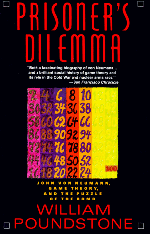
Prisoner's dilemma: John von Neumann, game theory and the puzzle of the bomb
By William Poundstone
This book is a curious mixture of biography, history and mathematics, all neatly packaged into an entertaining and enlightening read. In essence it is a biography of the brilliant and eccentric mathematician, John von Neumann, who began life, much like many of the other great mathematicians, by being able to do basic arithmatic before other children could speak and with an ability to calculate exceptionally well before he even went to school. It is an all too familiar story, but is more than usually true of von Neuman, and Poundstone tells the story well.
By birth, von Neumann was a Hungarian Jew, and he became part of the mass Jewish exodus from Central Europe during the years when the Nazis were coming to power. He was virulently anti-Communist, but though this may have informed his views on Cold War politics, it did not affect his maths. As Poundstone points out, despite much public misunderstanding, game theory is neither moral nor immoral. It is simply a branch of maths, and von Neumann's findings do not indicate any religious or political bias.
Von Neumann spent much of his working life at the RAND corporation, the first, and certainly the most famous, thinktank. He was also one of the Los Alamos group who helped make the atomic bomb, and in the hectic few years while he was there, his prodigious calculating skills were much used and appreciated. Sadly, although von Neumann was really the father of game theory, he has been overshadowed recently by another famous game theorist, John Nash, who was the subject of the recent biography and film, "A Beautiful Mind".
As well as giving us the details of von Neumann's life and work, Poundstone also gives us a good deal of Cold War history. Looking back from the 21st century, it is hard to remember that at one point it was generally believed that the world was doomed to imminent nuclear destruction, but this was exactly the environment in which von Neumann was working. World leaders really did propose pre-emptive strikes, and even the famous pacifist Bertrand Russell did, for a time, propose bombing the Soviet Union off the face of the earth before it could get the bomb.
Interwoven with these biography and history elements is an examination of the early development of game theory. The book eventually leaves von Neumann behind, with his death in 1957, and follows the path of game theory, and in particular two-person games. The provocative experiments in psychology and reasoning, and the evocatively-named Prisoners' Dilemma, Chicken, and the Dollar Auction, are all fascinatingly described.
In short, "Prisoner's Dilemma" is easier to read than many popular maths books, and more interesting than many history books. And when you consider that many of the questions raised by game theory in psychology and economics are still important and unanswered, you realise how relevant this book is to more than a narrow mathematical audience.
- Book details:
- Prisoner's dilemma: John von Neumann, game theory and the puzzle of the bomb
- William Poundstone
- paperback - 311 pages (1993)
- Anchor Books
- ISBN: 038541580X