
Home
plus.maths.org

Secondary menu

  • My list
  • About Plus
  • Sponsors
  • Subscribe
  • Contact Us
  • Log in
  • Main navigation

  • Home
  • Articles
  • Collections
  • Podcasts
  • Maths in a minute
  • Puzzles
  • Videos
  • Topics and tags
  • For

    • cat icon
      Curiosity
    • newspaper icon
      Media
    • graduation icon
      Education
    • briefcase icon
      Policy

    Popular topics and tags

    Shapes

    • Geometry
    • Vectors and matrices
    • Topology
    • Networks and graph theory
    • Fractals

    Numbers

    • Number theory
    • Arithmetic
    • Prime numbers
    • Fermat's last theorem
    • Cryptography

    Computing and information

    • Quantum computing
    • Complexity
    • Information theory
    • Artificial intelligence and machine learning
    • Algorithm

    Data and probability

    • Statistics
    • Probability and uncertainty
    • Randomness

    Abstract structures

    • Symmetry
    • Algebra and group theory
    • Vectors and matrices

    Physics

    • Fluid dynamics
    • Quantum physics
    • General relativity, gravity and black holes
    • Entropy and thermodynamics
    • String theory and quantum gravity

    Arts, humanities and sport

    • History and philosophy of mathematics
    • Art and Music
    • Language
    • Sport

    Logic, proof and strategy

    • Logic
    • Proof
    • Game theory

    Calculus and analysis

    • Differential equations
    • Calculus

    Towards applications

    • Mathematical modelling
    • Dynamical systems and Chaos

    Applications

    • Medicine and health
    • Epidemiology
    • Biology
    • Economics and finance
    • Engineering and architecture
    • Weather forecasting
    • Climate change

    Understanding of mathematics

    • Public understanding of mathematics
    • Education

    Get your maths quickly

    • Maths in a minute

    Main menu

  • Home
  • Articles
  • Collections
  • Podcasts
  • Maths in a minute
  • Puzzles
  • Videos
  • Topics and tags
  • Audiences

    • cat icon
      Curiosity
    • newspaper icon
      Media
    • graduation icon
      Education
    • briefcase icon
      Policy

    Secondary menu

  • My list
  • About Plus
  • Sponsors
  • Subscribe
  • Contact Us
  • Log in
  • 'The Queen's Conjuror'
    1 September, 2002
    September 2002

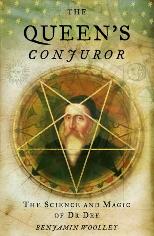
    The Queen's Conjuror - The life and magic of Dr Dee

    Although some people might find maths deadly boring, very few of us would think it could ever be deadly dangerous. But deadly it was in 16th century England, and one of those who followed the dangerous and mystical path of a mathematician was John Dee, the subject of this book.

    The book follows Dee's life, particularly focusing on his part in the very early stages of the scientific revolution. Like many of his contemporaries, Dee was a scholar of many subjects, including mathematics, astronomy, geography, astrology, physics, alchemy, law and philosophy. But at the time mathematics was still widely regarded with suspicion. "Mathematics was still popularly associated with the magical 'black arts', the term 'calculating' (sometimes corrupted to 'calculing') being synonymous with conjuration", Woolley says.

    Although regarded as a prominent scholar of his day, and at times a close confidant of Queen Elizabeth, Dee's reputation was always tainted by his fascination for the "dark arts". During the reign of Mary Queen of Scots Dee was charged with "calculating", "conjuring" and "witchcraft" and narrowly escaped with his life. His main focus in later life was reconciling the scientific and spiritual worlds, and he pursued divine knowledge and angelic communications at great personal cost.

    Woolley gives us a fascinating, balanced account of Dee's mystical exploration, a quest quite foreign to our modern scientific world. He suggests it was a reaction to the tumultuous times in which Dee lived. For the first time in 1,000 years humanity was no longer at the centre of the universe, and Dee hoped that Maths would restore the divine order.

    One of the central points of the book is its description of the interplay of science, philosophy, religion and magic that defined Dee's life. Like its subject, the book is scholarly, with numerous footnotes and references. However, these are not intrusive, and it is well written and very readable. It presents a fascinating account of Dee's life - both his personal life, and his role as one of the early scientific thinkers. It is not only Dee himself who is intriguing, but also the light cast on historical figures such as Queens Mary and Elizabeth and the early scientific community of mathematicians, geographers, philosophers and cranks who were beginning to discover the scientific reality that transformed their world into our modern one.

    Book details:
    The Queen's Conjuror
    Benjamin Woolley
    paperback - 405 pages (2001)
    Flamingo
    ISBN: 0006552021
    • Log in or register to post comments

    Read more about...

    book review
    University of Cambridge logo

    Plus is part of the family of activities in the Millennium Mathematics Project.
    Copyright © 1997 - 2025. University of Cambridge. All rights reserved.

    Terms