
Home
plus.maths.org

Secondary menu

  • My list
  • About Plus
  • Sponsors
  • Subscribe
  • Contact Us
  • Log in
  • Main navigation

  • Home
  • Articles
  • Collections
  • Podcasts
  • Maths in a minute
  • Puzzles
  • Videos
  • Topics and tags
  • For

    • cat icon
      Curiosity
    • newspaper icon
      Media
    • graduation icon
      Education
    • briefcase icon
      Policy

    Popular topics and tags

    Shapes

    • Geometry
    • Vectors and matrices
    • Topology
    • Networks and graph theory
    • Fractals

    Numbers

    • Number theory
    • Arithmetic
    • Prime numbers
    • Fermat's last theorem
    • Cryptography

    Computing and information

    • Quantum computing
    • Complexity
    • Information theory
    • Artificial intelligence and machine learning
    • Algorithm

    Data and probability

    • Statistics
    • Probability and uncertainty
    • Randomness

    Abstract structures

    • Symmetry
    • Algebra and group theory
    • Vectors and matrices

    Physics

    • Fluid dynamics
    • Quantum physics
    • General relativity, gravity and black holes
    • Entropy and thermodynamics
    • String theory and quantum gravity

    Arts, humanities and sport

    • History and philosophy of mathematics
    • Art and Music
    • Language
    • Sport

    Logic, proof and strategy

    • Logic
    • Proof
    • Game theory

    Calculus and analysis

    • Differential equations
    • Calculus

    Towards applications

    • Mathematical modelling
    • Dynamical systems and Chaos

    Applications

    • Medicine and health
    • Epidemiology
    • Biology
    • Economics and finance
    • Engineering and architecture
    • Weather forecasting
    • Climate change

    Understanding of mathematics

    • Public understanding of mathematics
    • Education

    Get your maths quickly

    • Maths in a minute

    Main menu

  • Home
  • Articles
  • Collections
  • Podcasts
  • Maths in a minute
  • Puzzles
  • Videos
  • Topics and tags
  • Audiences

    • cat icon
      Curiosity
    • newspaper icon
      Media
    • graduation icon
      Education
    • briefcase icon
      Policy

    Secondary menu

  • My list
  • About Plus
  • Sponsors
  • Subscribe
  • Contact Us
  • Log in
  • Solution to the taxi problem

    1 May, 1997
    May 1997


    We know that 85% of the taxis in Carborough are blue, the other 15% of taxis being green.

    Suppose that there's no bias for any particular blue or green taxi to be involved in such incidents. Then consider 100 possible cases (contingencies), in which taxis are involved, in proportion to their numbers. Each case is equally probable. We expect 85 cases to involve blue taxis, 15 to involve green. If a blue taxi were really involved, the witness might report blue (with 80% probability) or green (with 20% probability). If a green taxi were really involved, the witness might report blue (with 20% probability) or green (with 80% probability). The number of times that these outcomes are expected to occur in each of these four cases are shown in the table below. (Tables like this are called contingency tables.)
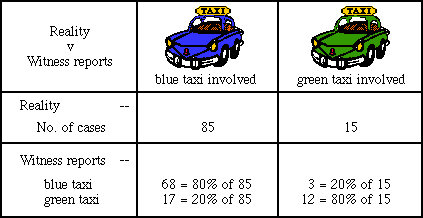
    Table: Reality v Witness reports

    So, given that the witness reported seeing a blue taxi, we must use the row in the table corresponding to the reported blue taxi. We have 68+3 = 71 equally likely cases and the probability that a blue taxi really was involved is 68/71 = 96%.

    A more interesting and surprising result is obtained in the case when the witness reports a green taxi. Many people on being asked this problem will say that if the witness reports a green taxi, then there is an 80% probability that a green taxi was involved. This however is incorrect, as the following argument shows. The contingency table is the same as above but now we must use the row in the table corresponding to the reported green taxi. We have 17+12 = 29 equally likely cases and the probability that a green taxi really was involved is 12/29 = 41%. The cases of correct identification of green are swamped by the false identifications of blue, and the witness's evidence is of no practical value.

    Further reading:

    New Scientist - "How right can you be?" by Robert Matthews, New Scientist 8 March 97. Matthews gives a full explanation and also describes other related problems.

    Mathematics Today, December 1996 p168 - "Why is Weather forecasting Still Under a Cloud?" by Robert Matthews. Matthews examines mathematically why accurate short term forecasts are often thought by the public to be incorrect.

    • Log in or register to post comments
    University of Cambridge logo

    Plus is part of the family of activities in the Millennium Mathematics Project.
    Copyright © 1997 - 2025. University of Cambridge. All rights reserved.

    Terms