
Home
plus.maths.org

Secondary menu

  • My list
  • About Plus
  • Sponsors
  • Subscribe
  • Contact Us
  • Log in
  • Main navigation

  • Home
  • Articles
  • Collections
  • Podcasts
  • Maths in a minute
  • Puzzles
  • Videos
  • Topics and tags
  • For

    • cat icon
      Curiosity
    • newspaper icon
      Media
    • graduation icon
      Education
    • briefcase icon
      Policy

    Popular topics and tags

    Shapes

    • Geometry
    • Vectors and matrices
    • Topology
    • Networks and graph theory
    • Fractals

    Numbers

    • Number theory
    • Arithmetic
    • Prime numbers
    • Fermat's last theorem
    • Cryptography

    Computing and information

    • Quantum computing
    • Complexity
    • Information theory
    • Artificial intelligence and machine learning
    • Algorithm

    Data and probability

    • Statistics
    • Probability and uncertainty
    • Randomness

    Abstract structures

    • Symmetry
    • Algebra and group theory
    • Vectors and matrices

    Physics

    • Fluid dynamics
    • Quantum physics
    • General relativity, gravity and black holes
    • Entropy and thermodynamics
    • String theory and quantum gravity

    Arts, humanities and sport

    • History and philosophy of mathematics
    • Art and Music
    • Language
    • Sport

    Logic, proof and strategy

    • Logic
    • Proof
    • Game theory

    Calculus and analysis

    • Differential equations
    • Calculus

    Towards applications

    • Mathematical modelling
    • Dynamical systems and Chaos

    Applications

    • Medicine and health
    • Epidemiology
    • Biology
    • Economics and finance
    • Engineering and architecture
    • Weather forecasting
    • Climate change

    Understanding of mathematics

    • Public understanding of mathematics
    • Education

    Get your maths quickly

    • Maths in a minute

    Main menu

  • Home
  • Articles
  • Collections
  • Podcasts
  • Maths in a minute
  • Puzzles
  • Videos
  • Topics and tags
  • Audiences

    • cat icon
      Curiosity
    • newspaper icon
      Media
    • graduation icon
      Education
    • briefcase icon
      Policy

    Secondary menu

  • My list
  • About Plus
  • Sponsors
  • Subscribe
  • Contact Us
  • Log in
  • Spiralling stars

    by
    K.E.M.
    1 May, 1999
    May 1999


    Using a telescope at the Keck Observatory in Hawaii, astronomers have discovered a new star where spun-off stellar material is being dragged into a spiralling tail.
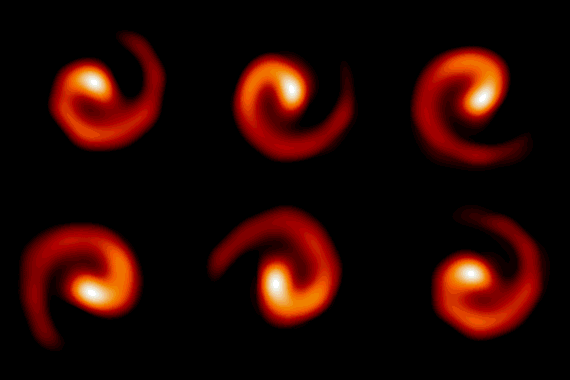
     WR104: a spiral pinwheel star. This is a movie based on real time-lapse images from April, June and September 1998 (c/o Space Sciences Laboratory, University of California at Berkeley).

    WR104: a spiral pinwheel star. This is a movie based on real time-lapse images from April, June and September 1998 (c/o Space Sciences Laboratory, University of California at Berkeley).

    Star WR104 is one of about 200 known so-called Wolf-Rayet stars (named after their discoverers). Such stars are in a phase where they are hot, massive and extremely luminous - typically three times the size, 25 times heavier and 100,000 times brighter than our own sun. In this relatively short-lived Wolf-Rayet phase, the pressure of the intensely bright emitted light can expel the star's outer atmosphere.

    Not all Wolf-Rayet stars will form a spiralling tail. The reason why WR104 appears as it does is that it has a companion star. As the two stars orbit around each other, WR104 shoots material around its companion and the circling orbits drag this into a spiral.

    APOD
    WR104 at Astronomy Picture of the Day.
    Blowing Bubbles
    A Wolf-Rayet Star Blows Bubbles, from Astronomy Picture Of The Day
    Exploding
    An exploding Wolf-Rayet star, from the Observatorium Hoher
    Read more about...
    Wolf-Rayet star
    • Log in or register to post comments

    Read more about...

    Wolf-Rayet star
    University of Cambridge logo

    Plus is part of the family of activities in the Millennium Mathematics Project.
    Copyright © 1997 - 2025. University of Cambridge. All rights reserved.

    Terms