
Home
plus.maths.org

Secondary menu

  • My list
  • About Plus
  • Sponsors
  • Subscribe
  • Contact Us
  • Log in
  • Main navigation

  • Home
  • Articles
  • Collections
  • Podcasts
  • Maths in a minute
  • Puzzles
  • Videos
  • Topics and tags
  • For

    • cat icon
      Curiosity
    • newspaper icon
      Media
    • graduation icon
      Education
    • briefcase icon
      Policy

    Popular topics and tags

    Shapes

    • Geometry
    • Vectors and matrices
    • Topology
    • Networks and graph theory
    • Fractals

    Numbers

    • Number theory
    • Arithmetic
    • Prime numbers
    • Fermat's last theorem
    • Cryptography

    Computing and information

    • Quantum computing
    • Complexity
    • Information theory
    • Artificial intelligence and machine learning
    • Algorithm

    Data and probability

    • Statistics
    • Probability and uncertainty
    • Randomness

    Abstract structures

    • Symmetry
    • Algebra and group theory
    • Vectors and matrices

    Physics

    • Fluid dynamics
    • Quantum physics
    • General relativity, gravity and black holes
    • Entropy and thermodynamics
    • String theory and quantum gravity

    Arts, humanities and sport

    • History and philosophy of mathematics
    • Art and Music
    • Language
    • Sport

    Logic, proof and strategy

    • Logic
    • Proof
    • Game theory

    Calculus and analysis

    • Differential equations
    • Calculus

    Towards applications

    • Mathematical modelling
    • Dynamical systems and Chaos

    Applications

    • Medicine and health
    • Epidemiology
    • Biology
    • Economics and finance
    • Engineering and architecture
    • Weather forecasting
    • Climate change

    Understanding of mathematics

    • Public understanding of mathematics
    • Education

    Get your maths quickly

    • Maths in a minute

    Main menu

  • Home
  • Articles
  • Collections
  • Podcasts
  • Maths in a minute
  • Puzzles
  • Videos
  • Topics and tags
  • Audiences

    • cat icon
      Curiosity
    • newspaper icon
      Media
    • graduation icon
      Education
    • briefcase icon
      Policy

    Secondary menu

  • My list
  • About Plus
  • Sponsors
  • Subscribe
  • Contact Us
  • Log in
  • Stolen science

    by
    Rachel Thomas
    19 November, 2002
    19/11/2002


    There may have been times when you wished that your maths or physics textbook would disappear, but you would have felt differently if it was a rare copy of one of the world's greatest scientific works. A first edition of Newton's Philosophiae Naturalis Principia Mathematica, (Mathematical Principles of Natural Philosophy), one of only 200 copies still in existence, was stolen by a reader from the Russian National Library on November 6.

    Newton's Principia was first published in 1687 and contains his revolutionary work on mechanics and cosmology. In it he states the three laws of motion known to all secondary school science students, and develops the universal law of gravitation. Using this mathematics he was able to explain phenomena such as eccentricities in the orbits of comets and the motion of the Moon, and the variation in the tides. Principia represented the culmination of the Scientific Revolution of the 16th and 17th centuries.
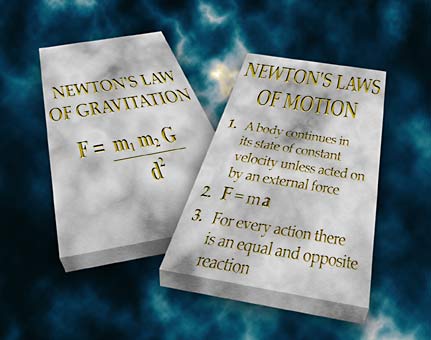
    Newton's laws

    The theft is now being investigated, but it is possible that it was stolen to order - there has been a recent spate of thefts of rare scientific works from European libraries and museums. On the open market a copy of Principia would sell for over £200,000, but its price on the black market may be even higher.

    You can be sure if the reader ever returns this overdue book, they will face more than a hefty library fine.

    Newton for President

    Well not quite ... Newton was in the running to be voted the Greatest Briton of all time on the BBC's series - Great Britons. As he was the only mathematician in the race, Plus was naturally barracking for Newton, but sadly Winston Churchill won. Still, Newton made it into the top ten, along with Darwin, Shakespeare and, er, Princess Diana...

    Read more about...
    Newton's Principia
    • Log in or register to post comments

    Read more about...

    Newton's Principia
    University of Cambridge logo

    Plus is part of the family of activities in the Millennium Mathematics Project.
    Copyright © 1997 - 2025. University of Cambridge. All rights reserved.

    Terms