'Strength in numbers'
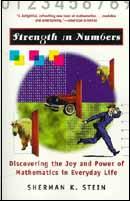
Strength in Numbers: Discovering the joy and power of mathematics in everyday life
Many popular books about mathematics combine elements of exposition and personal commentary, but few combine these disparate elements to the same extent as this book.
The commentary is of two kinds. There is quite a lot about trends in maths education, a subject about which Stein feels strongly, and on which he has thought deeply. He makes pragmatic suggestions for improvement - more thought to be given to the content and style of university undergraduate maths courses, from which so many teachers of maths graduate; exhortation to parents to become more involved; some suggestions for classroom activities, and so on. There is also a personal take on the pleasures of mathematics, both the subtle and the superficial ones. Superficial: for example his explanation that, although he likes the number 13 (because no one else does), his longtime favourite is 6; however, he has recently started to mention 3/5 "and not just to make it feel appreciated"! Subtle: some impassioned descriptions of the beauty of quite serious mathematics, and quite a few novel applications, from debunking psychics to proving that driving under the influence costs lives. A pragmatic man, he explains how he sets out to find the numbers he needs to answer the questions that interest him - for example, how much riskier is driving if you are drunk? - and he urges readers to search for their own data likewise.
There is also quite an amount of exposition, some of it reasonably advanced, for example, geometric series, irrational numbers, and even differentiation and integration. Stein has a sideline in history - his book "Archimedes: what did he do besides cry eureka?" was reviewed in Issue 21 of Plus - and he takes the opportunity to debunk various mathematical myths, for example that the Egyptians used a 3,4,5 knotted rope to mark a right angle, for which there is apparently no evidence.
The chapter on which careers use maths, and to what extent, is very useful, although quite US-centric. Less useful is the short chapter entitled "What is a job really?" which is essentially an uncritical restatement of the "lump of labour" fallacy, and is surprisingly economically illiterate, with its talk of "production stations" and "consumption stations".
The book is dedicated to "all who are willing to open closed doors and open even wider the doors already open" and the dedication is apt - as Stein says, we can all "explore the inner and outer worlds far more than we imagine possible".
- Book details:
- Strength in Numbers: Discovering the joy and power of mathematics in everyday life
- Sherman K. Stein
- paperback - 286 pages (2002)
- John Wiley & Sons Inc
- ISBN: 0471329746