

Outer space: Racing certainties

A few months ago I saw a TV crime drama that involved a plan to defraud bookmakers by nobbling the favourite for a race. The drama centred around other events and the basis for the betting fraud was never explained. What might have been going on?
Suppose that you have a race where there are published odds on the competitors of $a_{1}$ to 1, $a_{2}$ to 1, $a_{3}$ to 1, and so on for any number, $N$, of runners. For example, if the odds are 5 to 4 then we express that as an $a_{i}$ of 5/4 to 1. Now if we lay bets on all of the $N$ runners in proportion to the odds so that we bet a fraction $1/(a_{i}+1)$ of the total stake money on the runner with odds of $a_{i}$ to 1 then we will always show a profit so long as the odds satisfy the inequality $$ Q=\sum_{i=1}^{N}\frac{1}{a_{i}+1}<1, $$ and if $Q$ is less than $1$ then our winnings will be at least equal to $$ W=\left[ \frac{\ 1}{Q}-1\right] \times \mbox{our total stake}. $$
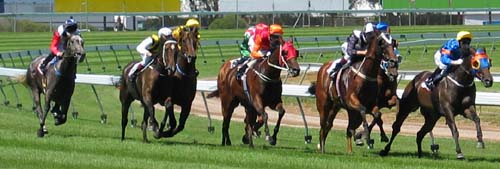
However, suppose that in the next race the odds on the four runners are 3 to 1, 7 to 1, 3 to 2 and 1 to 1 (ie evens). Now we see that we have $$ Q=\frac{1}{4}+\frac{1}{8}+\frac{2}{5}+\frac{1}{2}=\frac{51}{40}>1 $$ and there is no way that we can guarantee a positive return. Generally, we can see that if there is a large field of runners ($N$ is big) there is is likely to be a better chance of $Q$ being greater than 1. But large $N$ doesn't guarantee $Q>1$. Pick each of the odds by the formula $a_{i}=i(i+2)-1$ and you can get $Q=3/4$ and a healthy 30\% return even when $N$ is infinite!
But let's return to the TV programme. How is the situation changed if we know ahead of the race that the favourite in our $Q>1$ example will not be a contender because he has been doped?
Comments
Anonymous
Can you please provide some examples on the use of the formula ai = i ( i +2 ) - 1 for selecting the odds so as to show a profit.