

Home
plus.maths.org

Secondary menu

  • My list
  • About Plus
  • Sponsors
  • Subscribe
  • Contact Us
  • Log in
  • Main navigation

  • Home
  • Articles
  • Collections
  • Podcasts
  • Maths in a minute
  • Puzzles
  • Videos
  • Topics and tags
  • For

    • cat icon
      Curiosity
    • newspaper icon
      Media
    • graduation icon
      Education
    • briefcase icon
      Policy

    Popular topics and tags

    Shapes

    • Geometry
    • Vectors and matrices
    • Topology
    • Networks and graph theory
    • Fractals

    Numbers

    • Number theory
    • Arithmetic
    • Prime numbers
    • Fermat's last theorem
    • Cryptography

    Computing and information

    • Quantum computing
    • Complexity
    • Information theory
    • Artificial intelligence and machine learning
    • Algorithm

    Data and probability

    • Statistics
    • Probability and uncertainty
    • Randomness

    Abstract structures

    • Symmetry
    • Algebra and group theory
    • Vectors and matrices

    Physics

    • Fluid dynamics
    • Quantum physics
    • General relativity, gravity and black holes
    • Entropy and thermodynamics
    • String theory and quantum gravity

    Arts, humanities and sport

    • History and philosophy of mathematics
    • Art and Music
    • Language
    • Sport

    Logic, proof and strategy

    • Logic
    • Proof
    • Game theory

    Calculus and analysis

    • Differential equations
    • Calculus

    Towards applications

    • Mathematical modelling
    • Dynamical systems and Chaos

    Applications

    • Medicine and health
    • Epidemiology
    • Biology
    • Economics and finance
    • Engineering and architecture
    • Weather forecasting
    • Climate change

    Understanding of mathematics

    • Public understanding of mathematics
    • Education

    Get your maths quickly

    • Maths in a minute

    Main menu

  • Home
  • Articles
  • Collections
  • Podcasts
  • Maths in a minute
  • Puzzles
  • Videos
  • Topics and tags
  • Audiences

    • cat icon
      Curiosity
    • newspaper icon
      Media
    • graduation icon
      Education
    • briefcase icon
      Policy

    Secondary menu

  • My list
  • About Plus
  • Sponsors
  • Subscribe
  • Contact Us
  • Log in
  • Plus Advent Calendar Door #2: Who will come second?
    2 December, 2013
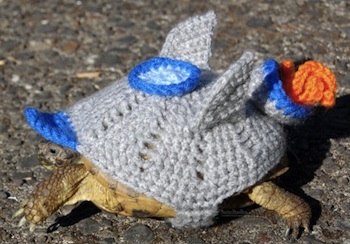
    Rocket tortoise!

    Will he rocket to the lead? (Most excellent tortoise suit by Katie Bradley.)

    Achilles and a tortoise are competing in a 100m sprint. Confident in his victory, Archilles lets the tortoise start 10m ahead of him. The race starts, Achilles zooms off and the tortoise starts bumbling along. When Achilles has reached the point A from where the tortoise started, it has crawled along by a small distance to point B. In a flash Achilles reaches B, but the tortoise is already at point C. When he reaches C, the tortoise is at D. When he's at D, the tortoise is at E. And so on. He's never going to catch up with the tortoise, so he has no chance of winning the race.

    Something's wrong here, but what? Let's assume that Achilles is ten times faster than the tortoise and that both are moving at constant speed. In the times it takes Achilles to travel the first 10m to point A, the tortoise, being ten times slower, has only moved by 1m to point B. By the time Achilles has travelled 1m to point B, the tortoise has crawled along by 0.1m to point C. And so on. After n such steps the tortoise has travelled $$ 1+1/10+1/100+1/1000+ \ldots +1/10^{(n-1)} \mbox{metres}. $$ And this is where the flaw of the argument lies. The tortoise will never cover the 90m it has to run using steps like these, no matter how many of them it takes. In fact, the distance covered in this way will never exceed $10/9=1.111\ldots$m. This is because the geometric progression $$ 1+1/10+1/100+1/1000+\ldots $$ converges to $10/9$. Since the tortoise is travelling at constant speed, it covers this distance in a finite time, and it's precisely when it's done that that Achilles overtakes it.

    This problem is known as one of Zeno's paradoxes after the ancient Greek philosopher Zeno, who used paradoxes like this one to argue that motion is just an illusion.

    Find out more about Zeno's paradoxes and infinite series on Plus.

    Return to the Plus Advent Calendar

    Read more about...
    Advent calendar 2013
    • Log in or register to post comments

    Anonymous

    10 December 2013

    Permalink

    I had heard this problem before, but I never knew why it doesn't work. This is a very insightful and clever article.

    • Log in or register to post comments

    Read more about...

    Advent calendar 2013
    University of Cambridge logo

    Plus is part of the family of activities in the Millennium Mathematics Project.
    Copyright © 1997 - 2025. University of Cambridge. All rights reserved.

    Terms