
Home
plus.maths.org

Secondary menu

  • My list
  • About Plus
  • Sponsors
  • Subscribe
  • Contact Us
  • Log in
  • Main navigation

  • Home
  • Articles
  • Collections
  • Podcasts
  • Maths in a minute
  • Puzzles
  • Videos
  • Topics and tags
  • For

    • cat icon
      Curiosity
    • newspaper icon
      Media
    • graduation icon
      Education
    • briefcase icon
      Policy

    Popular topics and tags

    Shapes

    • Geometry
    • Vectors and matrices
    • Topology
    • Networks and graph theory
    • Fractals

    Numbers

    • Number theory
    • Arithmetic
    • Prime numbers
    • Fermat's last theorem
    • Cryptography

    Computing and information

    • Quantum computing
    • Complexity
    • Information theory
    • Artificial intelligence and machine learning
    • Algorithm

    Data and probability

    • Statistics
    • Probability and uncertainty
    • Randomness

    Abstract structures

    • Symmetry
    • Algebra and group theory
    • Vectors and matrices

    Physics

    • Fluid dynamics
    • Quantum physics
    • General relativity, gravity and black holes
    • Entropy and thermodynamics
    • String theory and quantum gravity

    Arts, humanities and sport

    • History and philosophy of mathematics
    • Art and Music
    • Language
    • Sport

    Logic, proof and strategy

    • Logic
    • Proof
    • Game theory

    Calculus and analysis

    • Differential equations
    • Calculus

    Towards applications

    • Mathematical modelling
    • Dynamical systems and Chaos

    Applications

    • Medicine and health
    • Epidemiology
    • Biology
    • Economics and finance
    • Engineering and architecture
    • Weather forecasting
    • Climate change

    Understanding of mathematics

    • Public understanding of mathematics
    • Education

    Get your maths quickly

    • Maths in a minute

    Main menu

  • Home
  • Articles
  • Collections
  • Podcasts
  • Maths in a minute
  • Puzzles
  • Videos
  • Topics and tags
  • Audiences

    • cat icon
      Curiosity
    • newspaper icon
      Media
    • graduation icon
      Education
    • briefcase icon
      Policy

    Secondary menu

  • My list
  • About Plus
  • Sponsors
  • Subscribe
  • Contact Us
  • Log in
  • Einstein's evolving Universe
    30 May, 2014
    Einstein

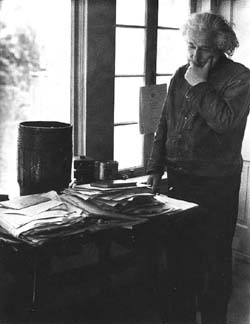
    Earlier this year we went along to the Cosmology and the constants of nature conference at the University of Cambridge, which brought together cosmologists and philosophers to discuss some of the big questions in cosmology. Physicist Cormac O' Raifeartaigh, from the Waterford Institute of Technology in Ireland, told us about his recent and unexpected discovery of an unpublished paper by Albert Einstein. The paper contains a model of the Universe that was dramatically different from any of the others that Einstein was known to have studied. And although it wasn't the model that Einstein, or the rest of the scientific community, eventually settled on, the discovery is important as it sheds light on how Einstein's thinking about the Universe changed, as he was dealing with some of the big questions in cosmology at the time.

    You can read more about O' Raifeartaigh's discovery in his blog Antimatter.

    • Log in or register to post comments

    Anonymous

    8 June 2014

    Permalink

    The last two episodes won't download. Their "enclosure url" tags seem to be missing the hostname part, i.e. http://plus.maths.org/

    • Log in or register to post comments

    plusadmin

    12 June 2014

    In reply to Podcast RSS feed problems by Anonymous

    Permalink

    Sorry about that - the feed is fixed now.

    • Log in or register to post comments
    You can listen to the podcast using the player above, and you can listen and subscribe to our podcast through Apple Podcasts, Spotify and through most other podcast providers via podbean.

    Read more about...

    Einstein
    philosophy of cosmology
    University of Cambridge logo

    Plus is part of the family of activities in the Millennium Mathematics Project.
    Copyright © 1997 - 2025. University of Cambridge. All rights reserved.

    Terms