Home
plus.maths.org

Secondary menu

  • My list
  • About Plus
  • Sponsors
  • Subscribe
  • Contact Us
  • Log in
  • Main navigation

  • Home
  • Articles
  • Collections
  • Podcasts
  • Maths in a minute
  • Puzzles
  • Videos
  • Topics and tags
  • For

    • cat icon
      Curiosity
    • newspaper icon
      Media
    • graduation icon
      Education
    • briefcase icon
      Policy

    Popular topics and tags

    Shapes

    • Geometry
    • Vectors and matrices
    • Topology
    • Networks and graph theory
    • Fractals

    Numbers

    • Number theory
    • Arithmetic
    • Prime numbers
    • Fermat's last theorem
    • Cryptography

    Computing and information

    • Quantum computing
    • Complexity
    • Information theory
    • Artificial intelligence and machine learning
    • Algorithm

    Data and probability

    • Statistics
    • Probability and uncertainty
    • Randomness

    Abstract structures

    • Symmetry
    • Algebra and group theory
    • Vectors and matrices

    Physics

    • Fluid dynamics
    • Quantum physics
    • General relativity, gravity and black holes
    • Entropy and thermodynamics
    • String theory and quantum gravity

    Arts, humanities and sport

    • History and philosophy of mathematics
    • Art and Music
    • Language
    • Sport

    Logic, proof and strategy

    • Logic
    • Proof
    • Game theory

    Calculus and analysis

    • Differential equations
    • Calculus

    Towards applications

    • Mathematical modelling
    • Dynamical systems and Chaos

    Applications

    • Medicine and health
    • Epidemiology
    • Biology
    • Economics and finance
    • Engineering and architecture
    • Weather forecasting
    • Climate change

    Understanding of mathematics

    • Public understanding of mathematics
    • Education

    Get your maths quickly

    • Maths in a minute

    Main menu

  • Home
  • Articles
  • Collections
  • Podcasts
  • Maths in a minute
  • Puzzles
  • Videos
  • Topics and tags
  • Audiences

    • cat icon
      Curiosity
    • newspaper icon
      Media
    • graduation icon
      Education
    • briefcase icon
      Policy

    Secondary menu

  • My list
  • About Plus
  • Sponsors
  • Subscribe
  • Contact Us
  • Log in
  • Maths in a minute: Tiling troubles

    25 August, 2015
    3 comments

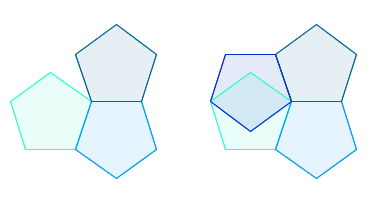
    Out of all the regular polygons there are only three you can use to tile a wall with: the square, the equilateral triangle, and the regular hexagon. All the others just won't fit together.
    Pentagons

    Trying to fit pentagons around a point.

    It's quite easy to prove this. A regular polygon with $n$ sides has interior angles of $180\frac{n-2}{n} \mbox{ degrees.}$ Suppose you try and make a tiling by fitting several copies, say $k$ of them, around a point so that they all meet at a corner (see the image above). Then the $k$ angles must add up to 360 degrees. If they add up to less there will be a gap, and if they add up to more then copies of the polygon will overlap. So we need $$k \times 180\frac{n-2}{n} = 360,$$ which means that $$ k = \frac{2n}{n-2}.$$ The term on the right hand side can be rewritten to give $$ k = \frac{4}{n-2}+2.$$ Since $k$ is a whole number (the number of copies of the polygon you are fitting together), this means that $4/(n-2)$ must also be a whole number. Therefore $n-2$ can only be equal to 4, 2, and 1, which means that $n$ can only be equal to 6, 4, and 3.
    Pentagons

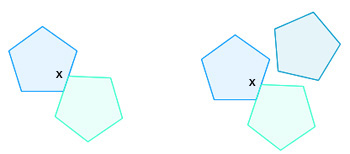
    Trying to fit a third polygon with two copies offset against each other.

    You could also try to make a tiling in which a corner of the polygon does not necessarily meet the corner of a neighbouring copy, but sits at some point $x$ along the neighbouring copy's side. That neighbouring copy would therefore have an interior angle of 180 degrees at $x$ (since $x$ is in the interior of one of its sides). To make a tiling you would have to fill the remaining 180 degrees with $k$ copies of the polygon, so you would need $$k \times 180 \frac{n-2}{n} = 180.$$ Using a similar argument as above you can convince yourself that this only works when $n=3$ or $n=4.$

    You can read more about tilings on Plus.

    • Log in or register to post comments

    Comments

    Anonymous

    26 August 2015

    Permalink

    You may not be able to tile a wall with pentagons, but you can make a really cool solid by lining the sides of pentagons... :-)

    • Log in or register to post comments

    math.nights

    26 February 2016

    Permalink

    The article translated into Arabic: https://goo.gl/AlRmbR

    • Log in or register to post comments

    GPM

    24 November 2016

    Permalink

    Of course it is possible to tile with non regular pentagons. There are 15 different types with the latest being discovered in 2015

    • Log in or register to post comments

    Read more about...

    tiling
    polygon
    Maths in a minute

    Our Podcast: Maths on the Move

    Our Maths on the Move podcast brings you the latest news from the world of maths, plus interviews and discussions with leading mathematicians and scientists about the maths that is changing our lives.

    Apple Podcasts
    Spotify
    Podbean

    Plus delivered to you

    Keep up to date with Plus by subscribing to our newsletter or following Plus on X or Bluesky.

    University of Cambridge logo

    Plus is part of the family of activities in the Millennium Mathematics Project.
    Copyright © 1997 - 2025. University of Cambridge. All rights reserved.

    Terms