Plus.Maths.org

tessellation
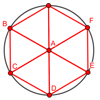
How should people arrange themselves for maximal socialising at a safe distance?
Our colleague Becky Warren has been distracting us with her wonderful tiling puzzles...
Tilings have adorned buildings from ancient Rome to the Islamic world, from Victorian England to colonial Mexico. But while it sometimes seems free from worldly limitations, tiling is a very precise art, where not much can be left to chance. We can push and turn and wiggle, but if the maths is not right, it isn't going to tile. Josefina Alvarez and Cesar L. Garcia investigate.
Many people find no beauty and pleasure in maths - but, as Lewis Dartnell explains, our brains have evolved to take pleasure in rhythm, structure and pattern. Since these topics are fundamentally mathematical, it should be no surprise that mathematical methods can illuminate our aesthetic sense.
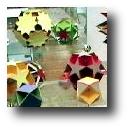
Science writer and exhibition researcher Alison Boyle tells Plus about her work creating up-to-the-minute news exhibits at the Science Museum in London.
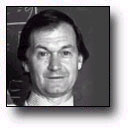
Will we ever be able to make computers that think and feel? If not, why not? And what has all this got to do with tiles? Plus talks to Sir Roger Penrose about all this and more.
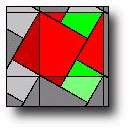
Bill Casselman writes about the intriguing amateur mathematician Henry Perigal, who took his elegant proof of Pythagoras' Theorem literally to his grave - by having it carved on his tombstone.
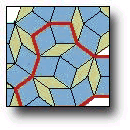
This pattern with kite-shaped tiles can be extended to cover any area, but however big we make it, the pattern never repeats itself. Alison Boyle investigates aperiodic tilings, which have had unexpected applications in describing new crystal structures.