






mathematics and art
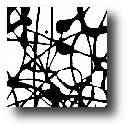
In the late 1940s, American painter Jackson Pollock dripped paint from a can on to vast canvases rolled out across the floor of his barn. Richard P. Taylor explains that Pollock's patterns are really fractals - the fingerprint of Nature.
Imagine stepping inside your favourite painting, walking around the light-filled music room of Vermeer's "The Music Lesson" or exploring the chapel in the "Trinity" painted by Masaccio in the 15th century. Using the mathematics of perspective, researchers are now able to produce three-dimensional reconstructions of the scenes depicted in these works.
Mathematics is helping the blind move forward and us all to step inside the past.
Whether you love maths or hate maths, your opinions on the subject were probably formed early. So primary teachers have a vital role to play in promoting mathematical skills. Plus meets primary teacher and maths coordinator Maureen Matthews.
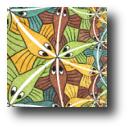
The work of Donald Coxeter, who died on 31 March 2003, will continue to inspire both mathematicians and artists.
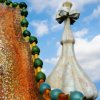
Carla Farsi is both an artist and a mathematician, who declared 2005 her Special Year for art and maths. Find out what she got up to, and what it's like being a part of both worlds.
Two designers tell us how they took the long way round to design, and how the maths and science they took in on the way helps them with their work today.

Exhibition design is not a career that the mathematically inclined tend to think about, let alone pursue. Barry Phipps is the first interdisciplinary fellow with the Kettle's Yard gallery in Cambridge. His remit is to develop projects of an interdisciplinary nature — "to find the common ground between things." Whilst most people think that art and science are two completely separate non-overlapping areas of human endeavour, Phipps does not see it this way.
Peter Markowich is a mathematician who likes to take pictures. At first his two interests seemed completely separate to him, but then he realised that behind every picture there is a mathematical story to tell. Plus went to see him to find out more, and ended up with a pictorial introduction to partial differential equations.
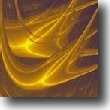
Images based on Lyapunov Exponent fractals are very striking. Andy Burbanks explains what Lyapunov Exponents are, what the much misunderstood phenomenon of chaos really is, and how you can iterate functions to produce marvellous images of chaos from simple mathematics.

Victoria Gould has always known she would be an actor, and went straight from studying arts at school to running her own theatre company. But she eventually had to come clean about her guilty secret - she loves maths - and has since managed to combine a career as a research mathematician and teacher with a successful acting career on television and in theatre. She tells Plus why she needs to use both sides of her brain.
In 1979 decorating work in a house in Vienna revealed a set of medieval frescoes depicting a cycle of songs by a 13th century poet, who was particularly fond of satirising the erotic relationships between knights and peasant maidens. The frescoes are of great historical significance, but they are badly damaged. In this article Carola Schönlieb explores how mathematicians use the heat equation to fill in the gaps.
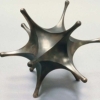
Mathematicians and artists mingle in London
Mathematics takes to the stage with A disappearing number, a work by Complicite, inspired by the mathematical collaboration of Hardy and Ramanujan. Rachel Thomas went to see the play, and explains some of the maths. You can also read her interview with Victoria Gould about how the show was created.
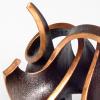
Many people find no beauty and pleasure in maths - but, as Lewis Dartnell explains, our brains have evolved to take pleasure in rhythm, structure and pattern. Since these topics are fundamentally mathematical, it should be no surprise that mathematical methods can illuminate our aesthetic sense.
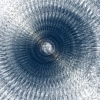
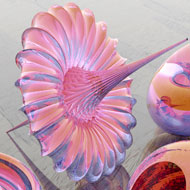
Computer-generated art is on the rise, and with it comes a further blurring of the boundaries between maths and art. Lewis Dartnell looks at some stunning examples.

Fractal Modelling of Pollock paintings called into question
Conversations across science and art
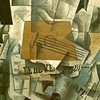
An unconventional perspective on an art show
Mathematics illustrates the forefront of visualising science