

This is the second in a series of two articles in which we look at topology using topographical features of maps. You may wish to read the first article on dividing walls, although the two articles are largely independent.
The Jordan Curve Theorem
A hermit hires some builders to construct a wall around his house. The wall they construct is shown in figure 1. Does the wall actually surround the house?
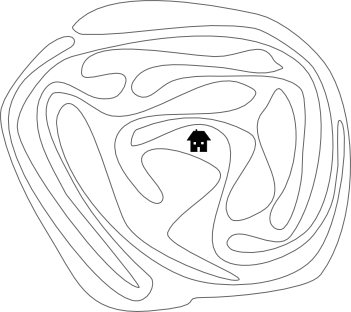
Figure 1: A house surrounded by a wall?
A Jordan curve in a plane is a continuous loop that doesn't intersect itself. The Jordan curve theorem states that each Jordan curve divides the plane into an inside region and an outside region. This is intuitively obvious, but difficult to prove on a more formal level (which we won't go into). But how can we establish whether the house lies inside or outside the Jordan curve?
First notice that each Jordan curve can be deformed, in a continuous fashion, to a circle, as indicated in figure 2.
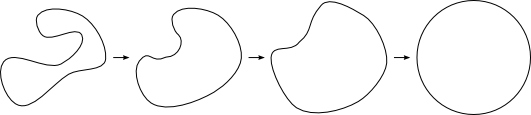
Figure 2: A continuous deformation of a Jordan curve to a circle.
Think of the Jordan curve as a loop of string, which you can deform (without it crossing itself at any stage) to a circle shape. If the builders had built a circular wall, we wouldn't have a problem because it is clear what is the inside and outside of a circle. Now imagine walking from the inside of a circular wall to the outside, along some arbitrary path, as shown in figure 3. How many times do you climb over the wall?
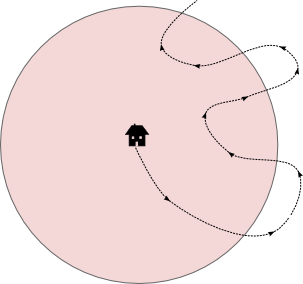
Figure 3: A path from the inside to the outside.
The answer is you climb over the wall an odd number of times, because each time you climb the wall you either move from inside to outside, or outside to inside. The same should be true of our original complicated wall! So let's take any path from the house to the outside, and count how many times we climb the wall (see Figure 4).
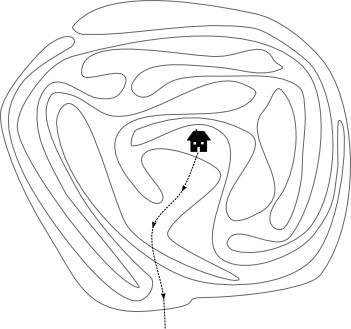
Figure 4: A path from the house to the outside.
The path crosses the wall four times. Four is not odd so the house does not lie inside the wall! Of course, I could have just clicked 'fill' when creating figure 1 and saved us having to think.
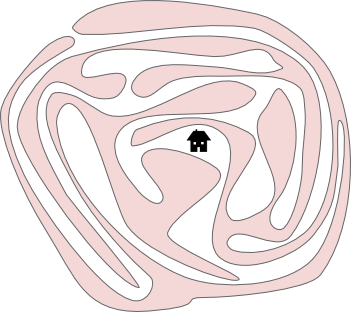
Figure 5: The original Jordan curve, with shaded interior.
Self-intersecting loops
The loops in the previous section each had an inside and an outside. What about the loop in figure 6; does the house lie inside or outside the loop?
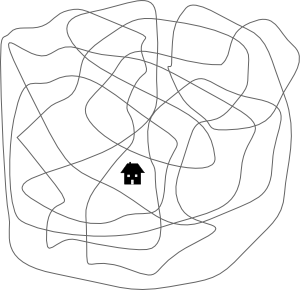
Figure 6: A self-intersecting loop.
Unlike the Jordan curves in the previous section, the loop in figure 6 intersects itself, and the meanings of inside and outside are no longer clear. We leave this issue for the moment (until the next section) and move on to a well-known, related problem.
In figure 7 there is a picture of the hermit's house, hung using a loop of string over two nails. If either nail is removed, the picture will still hang from the other nail (although it will be skewed). Is it possible, using an alternative loop, to hang the picture from the two nails in such a way that if either nail is removed, the picture falls?
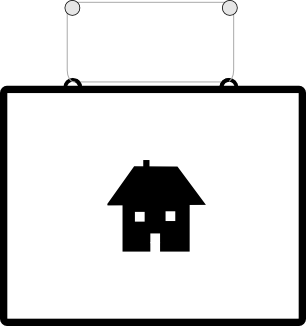
Figure 7: The hanging picture problem.
Winding numbers
Now let's try to solve these two problems. Jordan curves have an inside and an outside. A self-intersecting loop partitions the plane into more than two regions, and it is unclear which of these regions should be deemed to lie inside the loop, and which lie outside. We address this issue mathematically, using winding numbers.
Suppose there are three islands, shown in figure 8, on each of which is a lighthouse. The lighthouses are labelled A, B, and C. A drunken sailor steers a complicated loop round the islands (shown by a directed line in figure 8). Fearing a collision, each lighthouse focuses its beam on the sailor's ship for the entire loop. How many times, in total, does each lighthouse rotate whilst the ship traverses the loop once? Lighthouse A rotates twice anticlockwise. Lighthouse B rotates once clockwise. Lighthouse C rotates in total zero times anticlockwise. The winding number of the loop about a lighthouse is the total number of rotations of the lighthouse, where anticlockwise rotations are considered to be positive and clockwise rotations are considered to be negative. So the winding number of this loop about A is 2, the winding number about B is -1, and the winding number about C is 0.
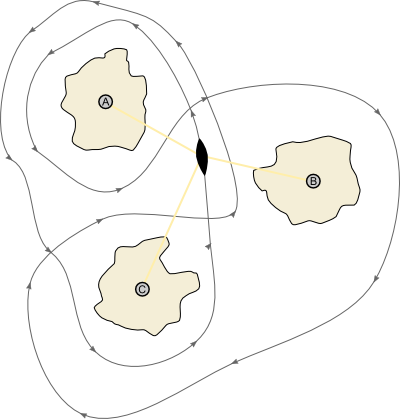
Figure 8: The route of the drunken sailor.
We don't need sailors and lighthouses to define winding numbers; we just need a directed loop (a loop with arrows) and a point (representing a lighthouse). Given such a loop  , and such a point
  we denote the winding number of
  about
about  by
by  So, for figure 8,
 and
and  In figure 9 we have removed the ship and the islands from figure 8, and labelled regions according to the winding numbers of points in that region.
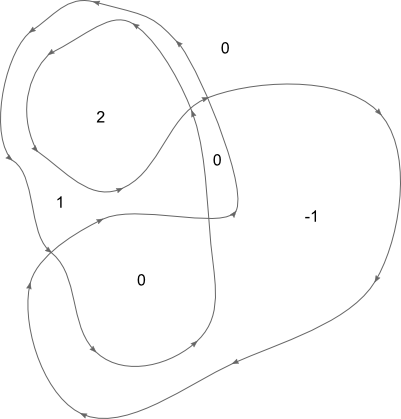
Figure 9: A directed loop with winding numbers labelled.
Why is the winding number constant within each region separated off by the loop? Here is an informal explanation. Consider two points  and
and  inside the same region. Let
  be another point in the region, very close to and not too close to the loop. Two lighthouses positioned at and will face in roughly the same direction as a ship sails round the loop. Therefore the winding numbers at and are equal. We can apply the same reasoning to the pair of points and
  where
where  is chosen to be close to
  and not too close to the loop. Continuing in this fashion we can create a sequence of points
  where each pair
  and
and  are close,
  and are close, and no point is too close to the loop. The winding numbers of all these points are the same, and hence the winding numbers about and are equal.
Notice that the infinite region surrounding a loop always has winding number 0, but there may be other regions of winding number 0 within the loop (as is the case in figure 9).
Deforming loops
In figure 2 we deformed a Jordan curve, in a continuous fashion, to a circle, without at any stage in the deformation process creating an intersection. We continue our study of continuous deformations of loops, and this time we allow intersections. We are interested in continuous deformations that do not cross a given point. See figure 10.
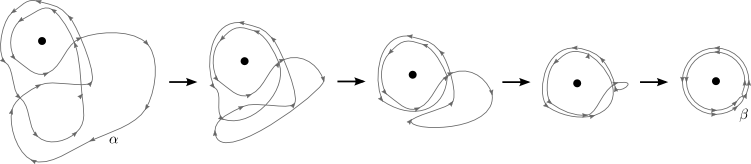
Figure 10: Continuous deformation of ⍺ to β without intersecting a point.
 be the black point shown in each loop of figure 10. We continuously deform the loop
  to the loop
  without ever crossing
  Notice that the winding number of about is equal to the winding number of about In fact, more generally the following is true: a loop can be continuously deformed to a loop without ever crossing a point if and only if the winding number of about is equal to the winding number of about This is a special case of Hopf’s degree theorem, which is a stronger result that holds in all dimensions, not just the plane. We will not prove this theorem here, but we use it in our final section when we return to the picture problem.
Calculating winding numbers
We asked of figure 6 whether the house lies inside or outside the loop. Once we have given the loop a direction, a more mature question is to ask for the winding number of the loop about the house. See figure 11, where the house is now replaced by a point.
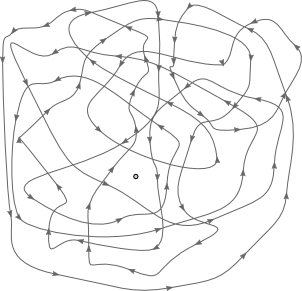
Figure 11: What is the winding number of the loop about the point?
 and
and  which are very close together, but on either side of a loop
  . As the ship traverses , the lighthouses will point in approximately the same direction except when the ship sails between them. When the ship sails between them, one lighthouse will rotate 180° clockwise, and the other will rotate 180° anticlockwise. See figure 12. Thus, in total, the winding number of about will differ by 1 from the winding number of about B.
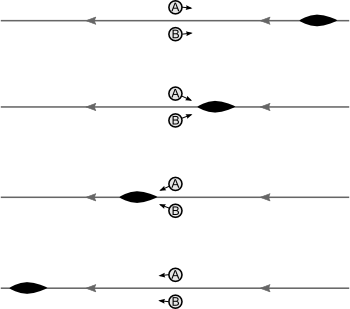
Figure 12: What is the winding number of the loop about the point?
 Construct a path from a point
  in the infinite region outside the loop to The winding number about is 0. Using the observation of figure 12 we can calculate the winding number in one region after another, from to
  being careful each time whether we should add or subtract one (depending on the direction of the arrows as we cross the loop). See figure 13; the winding number about
  is 2.
is 2.
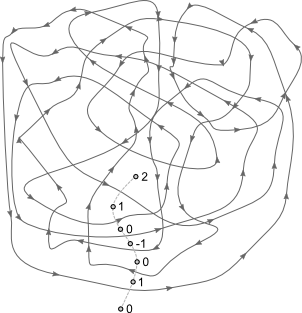
Figure 13: Winding numbers of adjacent regions differ by one.
Solution of the picture problem
We return to the picture problem described above. First, thinking topologically, we remove the picture as it is merely a distraction, and has no real bearing on the problem. We are left with two nails and a loop of string. Let us represent the nails by points and
and  and let
  denote the loop of string. We define a null loop to be a simple circular loop whose inside contains neither nor
  (see figure 14). This means that a null loop could not be used to hold up our picture. Notice that the winding number of the null loop about and is zero.
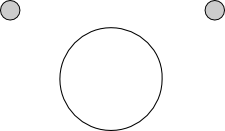
Figure 14: A null loop.
 is removed then
  can be continuously deformed, without crossing
  to the null loop (so the picture falls). By Hopf's degree theorem, this is possible if and only if
  Likewise, we require that
  So, we seek a loop whose winding number about and
  is zero. The null loop satisfies this, but any loop that can be continuously deformed, without crossing either or to the null loop wouldn't hold up the picture in the first place. So we must ignore such loops. A first solution to the picture problem is shown in figure 15. It cannot be continuously deformed to the null loop without crossing or and, once the loop is given a direction, the winding number about and is zero.
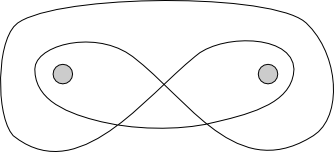
Figure 15: A simple solution.
Using our winding number calculating skills we can come up with more complicated solutions than that though; see for example figure 16.
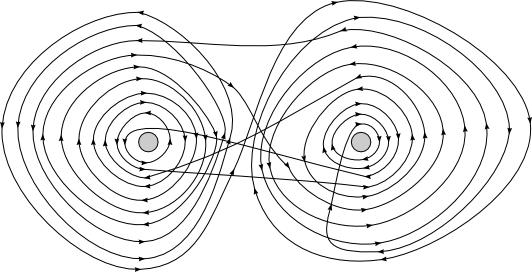
Figure 16: A complicated solution.
 or
or  For a deeper understanding of the problem, try researching the fundamental group. This will lead you into a branch of topology known as algebraic topology, which is concerned with the interaction between algebra and topology.
About the author

Ian Short is a lecturer in mathematics at the Open University. His mathematical interests include complex analysis, continued fractions, dynamical systems, hyperbolic geometry, and uncertainty.
Comments
Topology
Nice! Love it! Thanks! =))
Winding Numbers and Topology
Thanks so much. These are the types of explorations that brings math alive for students in Math Club.
Interesting article
Very nice article ... I enjoyed reading it.
Like a Sherpa into the
Like a Sherpa into the heights of theory, you took me where I didn't even know I could go. Thanks!