

Folding fractions
Can you fold a piece of paper in half? Of course you can, it’s easy, you just match the two corners along one side. But can you fold it in thirds? You might be able to fold it into thirds with a bit of fiddling and guessing, but what about into fifths? Or sevenths? Or thirteenths? Here is a simple way you can fold a piece of paper into any fraction you would like – exactly – no guessing or fiddling needed!
Folding a third
To start, take a square piece of paper and mark half way along top side with a small crease. Now fold the bottom left corner to meet this halfway mark and crease the paper.

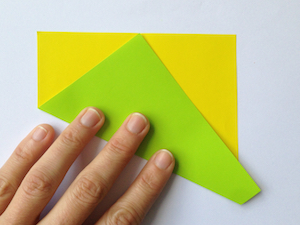
The first thing to notice is an interesting relationship between the three triangles you've created, one on the top-left, one on the top-right, and one on the bottom-left overhanging the side of the paper.
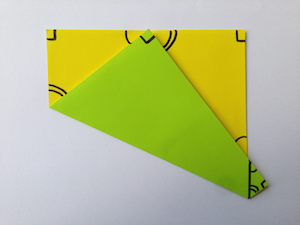
At the centre of the top edge three angles fit together to make 180 degrees. One of these is a right angle (marked with a square corner in the picture), which means that the pair of other angles (marked with the single and double lines in the picture) add to 90 degrees. Each of the angles of this pair also form part of a right-angled triangle (the top-right and top-left triangles), which means the other angle of the pair also appears in each of these right-angled triangles. And the bottom-right triangle also shares an angle with the top-right triangle. And, as it is also a right-angled triangle, it too contains the same pair of angles.
This all means that the three triangles are similar – they have the same shape. That is to say, they all have the same angles, and so, have the same ratios of lengths of their sides. We can use these similar triangles, along with Pythagoras' theorem, to fold the paper in thirds.
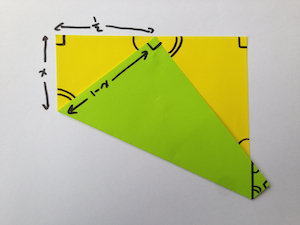
If we take the length of the side of our square paper to be 1, our top left triangle has one side of length $1/2$, one side of unknown length which we'll call $x$, giving the other side a length of $1-x$. Then, by Pythagoras' theorem, we know that $$ x^2+\left(\frac{1}{2}\right)^2 = (1-x)^2. $$ Expanding this out: $$ x^2+\frac{1}{4}=1-2x+x^2 $$ which, by rearranging, gives us $x=3/8$.
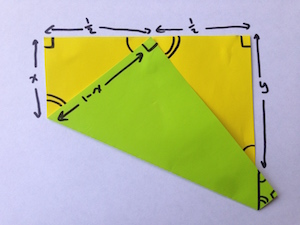
We can now calculate the length of the sides in the top-right triangle. This triangle has one side of length $1/2$ and another side of unknown length $y$. Because the triangles are similar we know that the ratio of the lengths of their sides must be the same. So $$ \frac{y}{\frac{1}{2}} = \frac{\frac{1}{2}}{x}. $$ And as $x=3/8$, we find that $y=2/3$. So we can construct $1/3$ by folding this length $y$ in half.
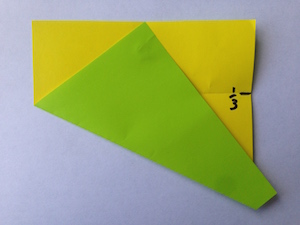
Folding any fraction
Kazuo Haga, a retired professor of biology from Japan, came up with this ingenious method. Although a biologist, he was very interested in using origami to explore mathematics (you can find our more in his fascinating book). In fact, Haga realised that this method was even more useful.
Suppose instead of folding your bottom left corner of the paper to some point halfway along the top edge, you instead fold the bottom left corner to a point a distance of $k$ along the top edge.
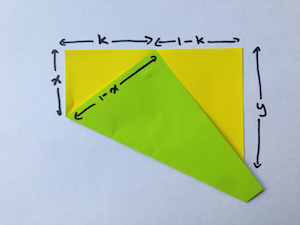
Then, the top-left triangle has sides of length $k$, $x$ and $1-x$. Then, as above, Pythagoras' theorem tells us that: $$ x^2+k^2=(1-x)^2 $$ which rearranged gives $x=(1-k^2)/2$. And by the similar triangles argument we have that $$ \frac{y}{1-k}=\frac{k}{x}. $$ If we put these two equations together we find $$ \frac{y}{1-k}=\frac{k}{(1-k^2)/2} $$ which can be rearranged as $$ y=\frac{2(1-k)k}{1-k^2}. $$ And (since $1-k^2=(1-k)(1+k)$) this can be simplified to $$ \frac{y}{2}=\frac{k}{1+k}. $$ This is known as Haga’s Theorem and it allows us to fold any fraction we would like from a square piece of paper.
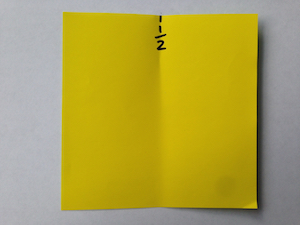
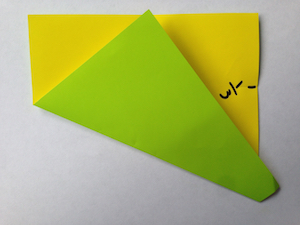
We've already seen $k=1/2$ allowed us to fold $1/3$. What if we rotate the square paper and fold the bottom left corner up to a point $1/3$ along the top edge? Then we have $k=1/3$ in Haga's Theorem which means that $$ \frac{y}{2}= \frac{1/3}{4/3}=1/4. $$
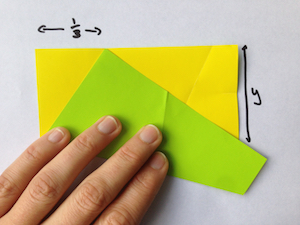
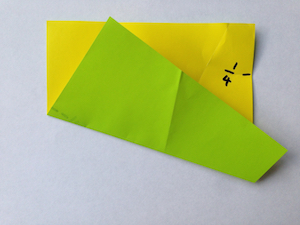
So far, starting from 1/2, we've used Haga's method to fold 1/3 and then 1/4. And if we carry on repeating this method we can fold any fraction. If we start with $k$ being some number $1/N$, then $$ \frac{y}{2}=\frac{1/N}{1+1/N}=\frac{1}{N+1}. $$ So by repeating Haga’s method over and over, we can construct every unit fraction (one with 1 in the numerator): folding 1/5....
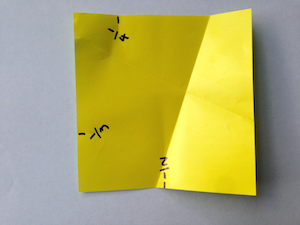
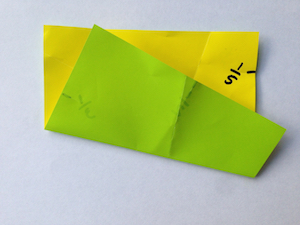
... folding 1/6....
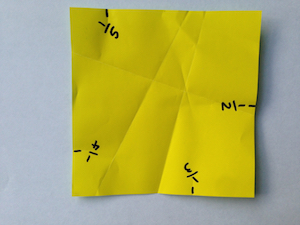
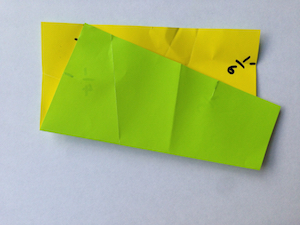
...folding 1/7...
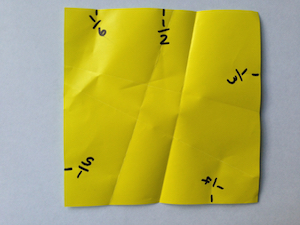
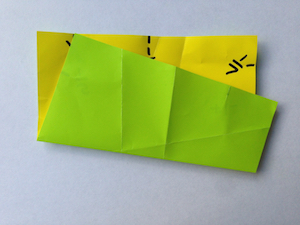
...and so on. And then we can use these to create any multiple of these unit fractions, and so fold any rational number. Hooray for Haga!
About the author
Rachel Thomas is Editor of Plus.
About this article
This article was inspired by content on our sister site Wild Maths, which encourages students to explore maths beyond the classroom and designed to nurture mathematical creativity. The site is aimed at 7 to 16 year-olds, but open to all. It provides games, investigations, stories and spaces to explore, where discoveries are to be made. Some have starting points, some a big question and others offer you a free space to investigate.
Comments
Anonymous
Very cool. Interesting that you can trisect a side, but this does *not* allow you to trisect an angle (i.e., fold a 30 degree angle at the corner) since this would require you to divide a side by 1/sqrt{3} which, alas, is *not* rational.
Anonymous
You can trisect an angle with folding. But you can't do so with a compass and ruler. See trisect angle
Anonymous
It's true you can't trisect an angle with a compass and ruler. But you can trisect an angle with folding/origami.
Anonymous
The link for Haga's book is broken
Marianne
Thanks for spotting that, we have fixed it.
Anonymous
Lovely idea .. just that in practice it's usually an A4 piece of paper that needs folding into thirds to fit in an envelope ... can anyone improve on this idea for this context?
Jon
Haga's method is great for squares, but you're right, it won't work very well for an A4 (or any rectangle) sheet. You will need to look at the crossing diagonals method for that. Fold one crease diagonally across the A4 sheet, and one line diagonally from one corner to halfway down the edge, and they will intersect at the 1/3 point.
Fu Wei
I have summerized 16 methods for trisecting A4 Paper:
https://www.flickr.com/photos/119967028@N08/48308136022/in/dateposted-p…
Anonymous
It is a nice article.
Haga's theorem are there,
http://www.origami.gr.jp/Archives/People/CAGE_/divide/02-e.html
Mathematics of paper folding,
http://en.wikipedia.org/wiki/Mathematics_of_paper_folding#cite_note-12
Haga's book, we can get by Amazon,
ORIGAMICS: MATHEMATICAL EXPOLORATIONS THROUGH PAPER FOLDING
Anonymous
It is not as elegant as the intercept theorem, thousands of years ago.
https://www.flickr.com/photos/129045076@N07/16394585596/in/set-72157650…
Anonymous
Please provide more information for the sections of which you work the equations out. I am still stuck on how you converted X^2+1/2^2=(1-X)^2 into X^2+1/4=1-2X+X^2. Please provide the answer to that equation in a comment or edit the page to include more information. Thanks :)
Marianne
You simply multiply out the brackets on each side of the equation: (1/2)^2=1/4 and (1-x)^2 = 1-2x+x^2.
Anonymous
This was really easy to follow for someone who knows how to do stuff with equations. It was really helpful and it looks like it took a while to make so thanks for putting in the effort.
Hiroshi Okumura
A generalization of Haga's fold and several new theorems can be seen in the paper "Haga's theorems in paper folding and related theorems in Wasan geometry Part 1". The paper can be dowload at http://sangaku-journal.eu/.
Hiroshi Okumura
The relationship between the two fractions can be obtained from
Theorem 3.1 in the paper. Thank you very much.
George Plousos
The same folding of the square has two more interesting properties. I have made their interactive constructions below (are activated by double clicking).
A famous result from Japan (1893)
https://www.geogebra.org/m/P8JF3mHB
Solution to the problem of doubling the cube
https://www.geogebra.org/m/hdEMmBWY