
Home
plus.maths.org

Secondary menu

  • My list
  • About Plus
  • Sponsors
  • Subscribe
  • Contact Us
  • Log in
  • Main navigation

  • Home
  • Articles
  • Collections
  • Podcasts
  • Maths in a minute
  • Puzzles
  • Videos
  • Topics and tags
  • For

    • cat icon
      Curiosity
    • newspaper icon
      Media
    • graduation icon
      Education
    • briefcase icon
      Policy

    Popular topics and tags

    Shapes

    • Geometry
    • Vectors and matrices
    • Topology
    • Networks and graph theory
    • Fractals

    Numbers

    • Number theory
    • Arithmetic
    • Prime numbers
    • Fermat's last theorem
    • Cryptography

    Computing and information

    • Quantum computing
    • Complexity
    • Information theory
    • Artificial intelligence and machine learning
    • Algorithm

    Data and probability

    • Statistics
    • Probability and uncertainty
    • Randomness

    Abstract structures

    • Symmetry
    • Algebra and group theory
    • Vectors and matrices

    Physics

    • Fluid dynamics
    • Quantum physics
    • General relativity, gravity and black holes
    • Entropy and thermodynamics
    • String theory and quantum gravity

    Arts, humanities and sport

    • History and philosophy of mathematics
    • Art and Music
    • Language
    • Sport

    Logic, proof and strategy

    • Logic
    • Proof
    • Game theory

    Calculus and analysis

    • Differential equations
    • Calculus

    Towards applications

    • Mathematical modelling
    • Dynamical systems and Chaos

    Applications

    • Medicine and health
    • Epidemiology
    • Biology
    • Economics and finance
    • Engineering and architecture
    • Weather forecasting
    • Climate change

    Understanding of mathematics

    • Public understanding of mathematics
    • Education

    Get your maths quickly

    • Maths in a minute

    Main menu

  • Home
  • Articles
  • Collections
  • Podcasts
  • Maths in a minute
  • Puzzles
  • Videos
  • Topics and tags
  • Audiences

    • cat icon
      Curiosity
    • newspaper icon
      Media
    • graduation icon
      Education
    • briefcase icon
      Policy

    Secondary menu

  • My list
  • About Plus
  • Sponsors
  • Subscribe
  • Contact Us
  • Log in
  • Maths in a minute: The catenary

    5 December, 2016
    7 comments

    When you suspend a chain from two hooks and let it hang naturally under its own weight, the curve it describes is called a catenary. Any hanging chain will naturally find this equilibrium shape, in which the forces of tension (coming from the hooks holding the chain up) and the force of gravity pulling downwards exactly balance.
    Wembley

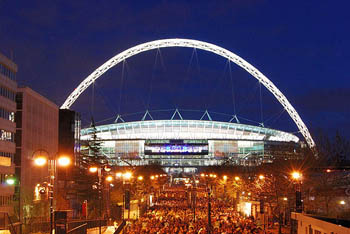
    The arch above Wembley Stadium is an inverted catenary. Image: Rob, CC BY 2.0.

    Something beautiful happens when you turn a catenary curve upside down. The inverted catenary will now describe an arch — and it turns out that it's the most stable shape an arch can have. In a hanging chain the forces of tension all act along the line of the curve. In the inverted catenary the forces of tension become forces of compression. And since these forces are directed along the line of the arch, the arch doesn't bend or buckle. If you want to build an arch, you should make sure it contains the shape of an inverted catenary. That way it will stand freely under its own weight and you'll also need to use a minimal amount of materials.

    The English architect Robert Hooke was the first to study the catenary mathematically and in 1675 published an anagram (in Latin) of : "As hangs the flexible line, so but inverted will stand the rigid arch." The arch above Wembley Stadium has the shape of a catenary and Christopher Wren also intended to use it in St. Paul's dome (find out more here).

    The equation of the catenary is $$\frac{a\left(e^{\frac{x}{a}}+e^{-\frac{x}{a}}\right)}{2}.$$ This gives a whole family of curves, one for each value of the parameter $a$, which determines the width of the catenary and also its lowest point above the $x$-axis.

    Use the Geogebra applet below to see catenaries for different values of a>0.

    • Log in or register to post comments

    Comments

    Bernardo

    6 December 2016

    Permalink

    When children play with a rope, where two hold each end, move the rope up and down and another jumps in the middle, is the shape of the rope a catenary while moving?

    • Log in or register to post comments

    barry

    25 October 2017

    In reply to When children play with a by Bernardo

    Permalink

    As with suspension bridges, when the forces ( usually a road deck) on the rope are high enough that the mass of the rope is negligible, the curve is parabolic. If the children twirl it very fast it will tend to a parabola, slower and stationary, a catenary.

    • Log in or register to post comments

    Andrew Spencer

    17 February 2021

    In reply to When children play with a by Bernardo

    Permalink

    Still a catenary but with a varying shaping force as the centripetal force of rotation is constant but as the rope rotates it adds to and subtracts from effect of gravity. It is like seeing the shape of the same chain on different planets as gravity changes

    • Log in or register to post comments

    Zeph

    12 April 2021

    In reply to When children play with a by Bernardo

    Permalink

    Note that the curve of a suspended chain or rope does not depend on the amount of gravity; it's the same curve whether gravity is strong or weak. So if the swinging rope were just exposed to a uniform increase in gravity, there would be no difference in shape.

    But a swinging jump rope is a bit different - the centripedal force needed to balance the rotation (so called centrifugal force) varies with the radius from the swinging axis. When the rope is at the bottom, each segment is subject to normal gravity plus a value which depends on its distance from the line between the handles. (And at the top or sides of the swinging path, other vector combinations of fixed gravity plus outward "centrifugal" force). This will create a different curve, but it is beyond my math to give you an equation for it.

    • Log in or register to post comments

    Quint

    15 May 2023

    In reply to When children play with a by Bernardo

    Permalink

    I believe the shape is a troposkein, like the ones used in certain vertical windmill designs.

    • Log in or register to post comments

    GreyFod

    19 January 2017

    Permalink

    Unless I'm very much mistaken, that looks like cosh :-)

    • Log in or register to post comments

    Jonathan

    8 April 2017

    In reply to Hyperbolic cosine by GreyFod

    Permalink

    It is cosh. (if a is 1)

    • Log in or register to post comments

    Read more about...

    catenary
    Maths in a minute

    Our Podcast: Maths on the Move

    Our Maths on the Move podcast brings you the latest news from the world of maths, plus interviews and discussions with leading mathematicians and scientists about the maths that is changing our lives.

    Apple Podcasts
    Spotify
    Podbean

    Plus delivered to you

    Keep up to date with Plus by subscribing to our newsletter or following Plus on X or Bluesky.

    University of Cambridge logo

    Plus is part of the family of activities in the Millennium Mathematics Project.
    Copyright © 1997 - 2025. University of Cambridge. All rights reserved.

    Terms