

Home
plus.maths.org

Secondary menu

  • My list
  • About Plus
  • Sponsors
  • Subscribe
  • Contact Us
  • Log in
  • Main navigation

  • Home
  • Articles
  • Collections
  • Podcasts
  • Maths in a minute
  • Puzzles
  • Videos
  • Topics and tags
  • For

    • cat icon
      Curiosity
    • newspaper icon
      Media
    • graduation icon
      Education
    • briefcase icon
      Policy

    Popular topics and tags

    Shapes

    • Geometry
    • Vectors and matrices
    • Topology
    • Networks and graph theory
    • Fractals

    Numbers

    • Number theory
    • Arithmetic
    • Prime numbers
    • Fermat's last theorem
    • Cryptography

    Computing and information

    • Quantum computing
    • Complexity
    • Information theory
    • Artificial intelligence and machine learning
    • Algorithm

    Data and probability

    • Statistics
    • Probability and uncertainty
    • Randomness

    Abstract structures

    • Symmetry
    • Algebra and group theory
    • Vectors and matrices

    Physics

    • Fluid dynamics
    • Quantum physics
    • General relativity, gravity and black holes
    • Entropy and thermodynamics
    • String theory and quantum gravity

    Arts, humanities and sport

    • History and philosophy of mathematics
    • Art and Music
    • Language
    • Sport

    Logic, proof and strategy

    • Logic
    • Proof
    • Game theory

    Calculus and analysis

    • Differential equations
    • Calculus

    Towards applications

    • Mathematical modelling
    • Dynamical systems and Chaos

    Applications

    • Medicine and health
    • Epidemiology
    • Biology
    • Economics and finance
    • Engineering and architecture
    • Weather forecasting
    • Climate change

    Understanding of mathematics

    • Public understanding of mathematics
    • Education

    Get your maths quickly

    • Maths in a minute

    Main menu

  • Home
  • Articles
  • Collections
  • Podcasts
  • Maths in a minute
  • Puzzles
  • Videos
  • Topics and tags
  • Audiences

    • cat icon
      Curiosity
    • newspaper icon
      Media
    • graduation icon
      Education
    • briefcase icon
      Policy

    Secondary menu

  • My list
  • About Plus
  • Sponsors
  • Subscribe
  • Contact Us
  • Log in
  • Outer space: On a clear day
    by
    John D. Barrow
    1 September, 2009
    September 2009
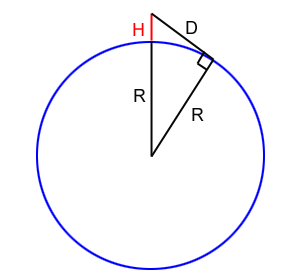
    <i>R</i> is the radius of the Earth, <i>H</i> is your height and <i>D</i> is how far you can see.

    R is the radius of the Earth, H is your height and D is how far you can see.


    ...You can see forever, according to Alan Lerner's Broadway musical. But can you? How far can you see? Just how far away is the horizon?

    Let's assume the Earth is smooth and spherical, so no intervening hills obscure your view, and ignore the effects of light refraction as it passes through the atmosphere, along with the effects of any rain or fog. If your eyes are a height $H$ above the ground and you look towards the horizon, then the distance to the horizon, $D$, is one side of a right-angled triangle whose other two sides are $H$ plus the radius $R$ of the Earth, and $R$. Using Pythagoras' theorem for this triangle we have

                                    $(H+R)^2 = R^2 + D^2.$

    <i>The wanderer above the sea of fog</i> by Caspar David Friedrich.

    The wanderer above the sea of fog by Caspar David Friedrich.

    Since the average radius of the Earth is about 6400 km and much greater than your height $H$, we can neglect $H^2$ compared to $R^2$ when multiplying out the square of $H+R$. This means that the straight-line distance to the horizon is just

                                    $D = \sqrt{2HR}$$

    to a very good approximation. If we put the radius of the Earth into the formula we get (measuring $H$ in metres)

                                    $D = 1600 \; metres \times \sqrt{5H} \approx \sqrt{5H}\; miles.$

    For someone of height 1.8m we have $\sqrt{5H} = 3$ and the distance to the horizon is $D = 4800$ metres, or 3 miles to very good accuracy. Notice that the distance that you can see increases like the square root of the height that you are viewing from, so if you go to the top of a hill that is 180 metres high you will be able to see about ten times further. From the top of the world's tallest building, the Burj Dubai in the Emirates you might see for 102 kilometres, or 64 miles. From the summit of Mount Everest you might see for 336 kilometres, or 210 miles - not quite forever, but far enough.

    Problem 1: Above we have calculated the straight-line distance to the horizon point. Show that if we take the curvature of the Earth into account, then the "walking" distance over the Earth's surface to the horizon point is $$R\cos^{-1}(R/(R+H)),$$ but this becomes equal to $(2RH)^{1/2}$ when we use the approximation that $R>>H$.

    Problem 2: You see something, like a cloud or a hot air balloon, high in the sky beyond the horizon and you know its maximum possible height above the ground. Can you work out how far away it could be?


    • Log in or register to post comments

    Read more about...

    pythagoras' theorem
    geometry
    outerspace

    Our Podcast: Maths on the Move

    Our Maths on the Move podcast brings you the latest news from the world of maths, plus interviews and discussions with leading mathematicians and scientists about the maths that is changing our lives.

    Apple Podcasts
    Spotify
    Podbean

    Plus delivered to you

    Keep up to date with Plus by subscribing to our newsletter or following Plus on X or Bluesky.

    University of Cambridge logo

    Plus is part of the family of activities in the Millennium Mathematics Project.
    Copyright © 1997 - 2025. University of Cambridge. All rights reserved.

    Terms