
Home
plus.maths.org

Secondary menu

  • My list
  • About Plus
  • Sponsors
  • Subscribe
  • Contact Us
  • Log in
  • Main navigation

  • Home
  • Articles
  • Collections
  • Podcasts
  • Maths in a minute
  • Puzzles
  • Videos
  • Topics and tags
  • For

    • cat icon
      Curiosity
    • newspaper icon
      Media
    • graduation icon
      Education
    • briefcase icon
      Policy

    Popular topics and tags

    Shapes

    • Geometry
    • Vectors and matrices
    • Topology
    • Networks and graph theory
    • Fractals

    Numbers

    • Number theory
    • Arithmetic
    • Prime numbers
    • Fermat's last theorem
    • Cryptography

    Computing and information

    • Quantum computing
    • Complexity
    • Information theory
    • Artificial intelligence and machine learning
    • Algorithm

    Data and probability

    • Statistics
    • Probability and uncertainty
    • Randomness

    Abstract structures

    • Symmetry
    • Algebra and group theory
    • Vectors and matrices

    Physics

    • Fluid dynamics
    • Quantum physics
    • General relativity, gravity and black holes
    • Entropy and thermodynamics
    • String theory and quantum gravity

    Arts, humanities and sport

    • History and philosophy of mathematics
    • Art and Music
    • Language
    • Sport

    Logic, proof and strategy

    • Logic
    • Proof
    • Game theory

    Calculus and analysis

    • Differential equations
    • Calculus

    Towards applications

    • Mathematical modelling
    • Dynamical systems and Chaos

    Applications

    • Medicine and health
    • Epidemiology
    • Biology
    • Economics and finance
    • Engineering and architecture
    • Weather forecasting
    • Climate change

    Understanding of mathematics

    • Public understanding of mathematics
    • Education

    Get your maths quickly

    • Maths in a minute

    Main menu

  • Home
  • Articles
  • Collections
  • Podcasts
  • Maths in a minute
  • Puzzles
  • Videos
  • Topics and tags
  • Audiences

    • cat icon
      Curiosity
    • newspaper icon
      Media
    • graduation icon
      Education
    • briefcase icon
      Policy

    Secondary menu

  • My list
  • About Plus
  • Sponsors
  • Subscribe
  • Contact Us
  • Log in
  • Some like it hot

    by
    Marianne Freiberger
    3 November, 2016
    Structure

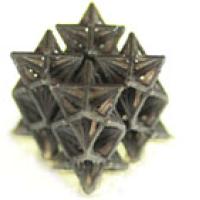
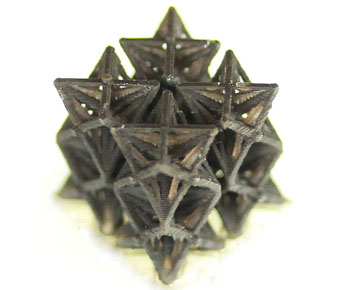
    This star-shaped structure shrinks when heated up. Image: Qiming Wang, CC BY-NC-ND 3.0.

    Clever geometry can do wonderful things. A team of engineers has produced a material that shrinks when it's heated. This is in contrast to most other materials that expand in the heat, and will be useful in all sorts of contexts where it's important that materials don't get bigger when hot: from making computer chips to producing high precision optical and mechanical devices, and even the fillings in your teeth. And it's all down to the clever geometry of the material's structure.

    The structure is based on tiny components of interlocking beams with empty space between them. The beams are made from two different materials — a polymer substance and a copper-containing one — that react differently to heat. Both expand when heated, but the internal beams expand faster, and are arranged so that they pull the surface beams inward as they do so. As a result, the structure occupies less space: it shrinks. The idea goes back quite a few years, but it's only now, with the team's pioneering 3D printing technique that these delicate structures can actually be produced.

    The team, led by Nicholas X. Fang of the Massachusetts Institute of Technology, tested their structures in the lab, but they also came up with a mathematical formula and a computational model to describe the geometry of the structures and their response to heat. The amount of shrinkage can be tuned by varying the amount of copper contained in one of the composite materials and by changing the geometrical arrangement of the beams. And although the structures are only about as big as sugar cubes, they can be fitted together like tiles to make up bigger ones that retain the shrinking property.

    It takes a pretty high temperature to achieve the shrinkage — around 280 degrees Celsius — and the amount by which the structures shrink is tiny. But that's ok: engineers typically aren't after materials that shrink, but materials that don't expand in the heat, so these ones look like they'll fit the bill.

    Read more about...
    engineering
    geometry
    • Log in or register to post comments

    Read more about...

    engineering
    geometry
    University of Cambridge logo

    Plus is part of the family of activities in the Millennium Mathematics Project.
    Copyright © 1997 - 2025. University of Cambridge. All rights reserved.

    Terms