Home
plus.maths.org

Secondary menu

  • My list
  • About Plus
  • Sponsors
  • Subscribe
  • Contact Us
  • Log in
  • Main navigation

  • Home
  • Articles
  • Collections
  • Podcasts
  • Maths in a minute
  • Puzzles
  • Videos
  • Topics and tags
  • For

    • cat icon
      Curiosity
    • newspaper icon
      Media
    • graduation icon
      Education
    • briefcase icon
      Policy

    Popular topics and tags

    Shapes

    • Geometry
    • Vectors and matrices
    • Topology
    • Networks and graph theory
    • Fractals

    Numbers

    • Number theory
    • Arithmetic
    • Prime numbers
    • Fermat's last theorem
    • Cryptography

    Computing and information

    • Quantum computing
    • Complexity
    • Information theory
    • Artificial intelligence and machine learning
    • Algorithm

    Data and probability

    • Statistics
    • Probability and uncertainty
    • Randomness

    Abstract structures

    • Symmetry
    • Algebra and group theory
    • Vectors and matrices

    Physics

    • Fluid dynamics
    • Quantum physics
    • General relativity, gravity and black holes
    • Entropy and thermodynamics
    • String theory and quantum gravity

    Arts, humanities and sport

    • History and philosophy of mathematics
    • Art and Music
    • Language
    • Sport

    Logic, proof and strategy

    • Logic
    • Proof
    • Game theory

    Calculus and analysis

    • Differential equations
    • Calculus

    Towards applications

    • Mathematical modelling
    • Dynamical systems and Chaos

    Applications

    • Medicine and health
    • Epidemiology
    • Biology
    • Economics and finance
    • Engineering and architecture
    • Weather forecasting
    • Climate change

    Understanding of mathematics

    • Public understanding of mathematics
    • Education

    Get your maths quickly

    • Maths in a minute

    Main menu

  • Home
  • Articles
  • Collections
  • Podcasts
  • Maths in a minute
  • Puzzles
  • Videos
  • Topics and tags
  • Audiences

    • cat icon
      Curiosity
    • newspaper icon
      Media
    • graduation icon
      Education
    • briefcase icon
      Policy

    Secondary menu

  • My list
  • About Plus
  • Sponsors
  • Subscribe
  • Contact Us
  • Log in
  • Saving the economy with Plus
    11 October, 2011
    Laureates

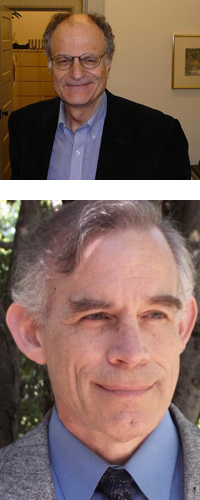
    Thomas Sargent (top) and Christopher Sims.

    With European governments struggling to avert imminent disaster in the Euro zone, the award of this year's Nobel Memorial Prize in Economic Sciences could not be more relevant. The prize has gone to Thomas Sargent and Christopher Sims whose work explores how and if policy decisions can affect the economy and how unexpected shocks spread through it.

    Maths and stats are central to economics and finance — so to celebrate their role we've had a look through our archive for our favourite articles on the subject. Who knows? Maybe they'll help save the Euro!

    • Adam Smith and the invisible hand: a game theoretical look at Smith's famous invisible hand mechanism.
    • What is financial mathematics?
    • How maths killed Lehman Brothers
    • Is maths to blame? a look at the credit crunch
    • A risky business: How to price derivatives
    • Rogue trading: more on derivatives
    • What can birds tell us about flying through ash clouds?
    • Leaving the markets: the 2010 Nobel Prize in Economics shows that it's not all about the markets.
    • The economics of health: what makes value for money in medicine?
    • Game theory wins Nobel Prize: the 2005 Prize went for work on conflict and cooperation
    • Career interview: Financial engineer
    • Career interview: Financial maths course director
    Read more about...
    Nobel prize
    • Log in or register to post comments

    Read more about...

    Nobel prize
    University of Cambridge logo

    Plus is part of the family of activities in the Millennium Mathematics Project.
    Copyright © 1997 - 2025. University of Cambridge. All rights reserved.

    Terms