








tiling

Is the Universe finite, with an edge, or infinite, with no edges? Or is it even stranger: finite but with no edges? It sounds far-fetched but the mathematical theory of topology makes it possible, and nobody yet knows the truth. Janna Levin tells us more.

Last October, two mathematicians won £1m when it was revealed that they were the first to solve the Eternity jigsaw puzzle. It had taken them six months and a generous helping of mathematical analysis. Mark Wainwright meets the pair and finds out how they did it.

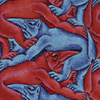
If you've ever redecorated a bathroom, you'll know that there are only so many ways in which you can tile a flat plane. But once you move into the curved world of hyperbolic geometry, possibilities become endless and the most amazing fractal structures ensue. Caroline Series and David Wright give a short introduction to the maths behind their beautiful images.
We've all heard of origami. It's all about making paper birds and pretty boxes, and is really just a game invented by Japanese kids, right? Prepare to be surprised as Liz Newton takes you on a journey of origami, maths and science.
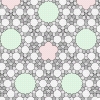
Squares do it, triangles do it, even hexagons do it — but pentagons don't. They just won't fit together to tile a flat surface. So are there any tilings based on fiveness? Craig Kaplan takes us through the five-fold tiling problem and uncovers some interesting designs in the process.
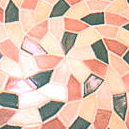
Tilings have adorned buildings from ancient Rome to the Islamic world, from Victorian England to colonial Mexico. But while it sometimes seems free from worldly limitations, tiling is a very precise art, where not much can be left to chance. We can push and turn and wiggle, but if the maths is not right, it isn't going to tile. Josefina Alvarez and Cesar L. Garcia investigate.