





click here for the plus home page
© 1997-2009, Millennium Mathematics Project, University of Cambridge.
Permission is granted to print and copy this page on paper for non-commercial use. For other uses, including electronic redistribution, please contact us.
Do you know what's good for you?
icon

Understand the maths behind health and medicine

Careers with maths
icon

Gavin Harper is a mathematician working right at the heart of genetics

A favourite from the archive...
Subscribe to our RSS feed:
AddThis Feed Button subscribe to our RSS feed
 
March 2010
Tags

ellipse

Feature icon

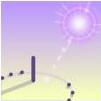
We've all seen a traditional sundial, where a triangular wedge is used to cast a shadow onto a marked-out dial - but did you know that there is another kind? In this article, Chris Sangwin and Chris Budd tell us about a different kind of sundial, the analemmatic design, where you can use your own shadow to tell the time.
Tags: trigonometry : Projection : declination of the sun : angular distance : ellipse : sundial


Feature icon

In issue 29 of Plus, we heard how a simple mathematical equation became the subject of a debate in the UK parliament. Chris Budd and Chris Sangwin continue the story of the mighty quadratic equation.
Tags: bernoulli equation : navier-stokes equations : gravity : ellipse : chaos : differential equation : public understanding of mathematics : quadratic equation : circle : parabola : hyperbola : acceleration : stopping time : galileo : Newton : pendulum : Euler : complex number : logistic map : copernicus : kepler


Feature icon

It isn't often that a mathematical equation makes the national press, far less popular radio, or most astonishingly of all, is the subject of a debate in the UK parliament. However, as Chris Budd and Chris Sangwin tell us, in 2003 the good old quadratic equation, which we all learned about in school, reached these dizzy pinnacles of fame.
Tags: ellipse : pythagoras' theorem : golden ratio : public understanding of mathematics : quadratic equation : Fibonacci : Babylonian mathematics : Newton-Raphson method : completing the square : circle : parabola : hyperbola


Feature icon

The geometry says that now is the right time for a mission to Mars.
Tags: NASA : ellipse : Mars : Newton : kepler : Kepler's three laws of planetary motion : orbit : European Space Agency : perihelion : aphelion


Feature icon

Why do so many people say they hate mathematics, asks David Acheson? The truth, he says, is that most of them have never been anywhere near it, and that mathematicians could do more to change this perception - perhaps by emphasising the element of surprise that so often accompanies mathematics at its best.
Tags: proof : Fermat's Last Theorem : ellipse : geometry : Pi : pendulum : kepler : mathematics and magic : leibniz : focal points : linked pendulums


Feature icon

Johannes Kepler (1571-1630) is now chiefly remembered as a mathematical astronomer who discovered three laws that describe the motion of the planets. J.V. Field continues our series on the origins of proof with an examination of Kepler's astronomy.
Tags: history of mathematics : gravity : proof : ellipse : astronomy : geometry : Kepler's three laws of planetary motion : error


Feature icon

Adding weight helps Earth dodge killer asteroids

Tags: ellipse : astronomy : geometry : asteroid : asteroid collision