







astronomy
Science writer and exhibition researcher Alison Boyle tells Plus about her work creating up-to-the-minute news exhibits at the Science Museum in London.
Mathematics makes a clean sweep in the Nobel Prizes.
What's the risk of climate change or passive smoking? Why do penguins rotate their eggs? What makes mathematicians reach out for god? And how did we evolve the maths behind these questions? Find some answers in this political, psychological, philosophical and physical issue of Plus, and do some real sums with our interactive checker board.
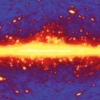
One of the many strange ideas from quantum mechanics is that space isn't continuous but consists of tiny chunks. Ordinary geometry is useless when it comes to dealing with such a space, but algebra makes it possible to come up with a model of spacetime that might do the trick. And it can all be tested by a satellite. Shahn Majid met up with Plus to explain.
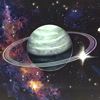
Sophie Butchart finds mysterious patterns in the solar system
Johannes Kepler (1571-1630) is now chiefly remembered as a mathematical astronomer who discovered three laws that describe the motion of the planets. J.V. Field continues our series on the origins of proof with an examination of Kepler's astronomy.
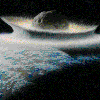
Asteroid just missed Earth
It's International Year of Astronomy and all eyes are on Galileo Galilei, whose astronomical observations 400 years ago revolutionised our understanding of the Universe. But few people know that Galileo wasn't the first to build a telescope and turn it on the stars. That honour falls to a little-known mathematician called Thomas Harriot, who excelled in many other ways too. Anna Faherty takes us on a tour of his work.
A public discussion explores deep questions
In the last issue Lewis Dartnell explained how chaos on the brain is not only unavoidable but also beneficial. Now he tells us why the same is true for our solar system and sends us on a journey that has been travelled by comets and spacecraft.
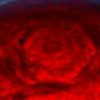
We may not have found life out there, but there is a hexagon on Saturn.
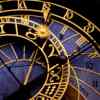
A brief history of time keeping

Find out if the unchanginge features of the Universe really are unchanging
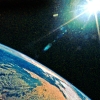
On the 25th of May 1997 a dramatic collision tore a hole into the space station Mir and sent it hurtling through space. As NASA astronaut Michael Foale tells Plus, the fate of Mir and its crew hinged on a classical set of equations.
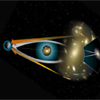
Solving two unrelated problems at once
This is the 50th issue of Plus and to celebrate, we've made it especially big. We explore the incredibly life-like images generated by computers and fragile medieval frescoes, find chaos in fluid flows and prime numbers in a sieve, meet the "English Galileo" and a man who's into geeky pop, and learn about the dangers of bacon sandwiches. Plus the usual regular features including book reviews, puzzle and podcasts.
Has the precious cargo of the crashed Genesis mission survived to tell us about the origins of our solar system?
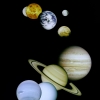
The world celebrates a great anniversary and Plus joins the party
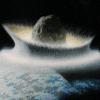
Adding weight helps Earth dodge killer asteroids
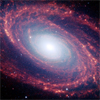
Find out with Martin Rees
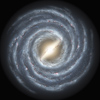
Scientists crack black holes' balancing act
And what are gravitational waves?