
News story
Article
An infinite series of surprises
Infinite series occupy a central and important place in mathematics. C. J. Sangwin shows us how eighteenth-century mathematician Leonhard Euler solved one of the foremost infinite series problems of his day.
Article
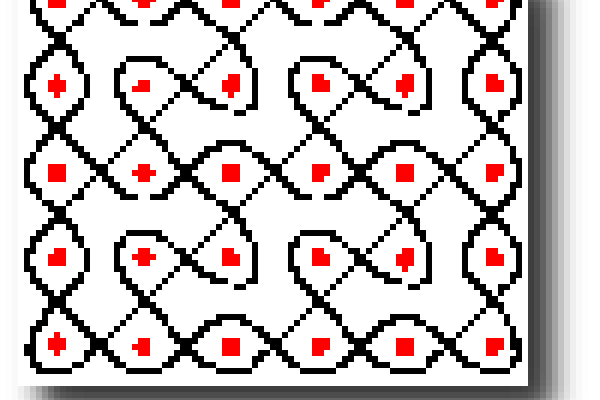
New designs from Africa
Paulus Gerdes takes us on a tour of the mathematical properties of some beautiful designs inspired by the traditional art of Angolan tribespeople.
Article
Mathematical mysteries: Strange Geometries
The famous mathematician Euclid is credited with being the first person to axiomatise the geometry of the world we live in - that is, to describe the geometric rules which govern it. Based on these axioms, he proved theorems - some of the earliest uses of proof in the history of mathematics.
Article

Mathematical mysteries: Survival of the nicest?
One of the most puzzling aspects of human behaviour is cooperation, in situations where backstabbing and selfishness would seem to be more rewarding. From the point of view of evolutionary theory, the very existence of altruism and cooperation appear mysterious.
Article

Stephen Hawking's 60 years in a nutshell
Plus is very proud to present Professor Stephen Hawking's own Birthday Symposium address.
Article

Roger Penrose: A Knight on the tiles
Will we ever be able to make computers that think and feel? If not, why not? And what has all this got to do with tiles? Plus talks to Sir Roger Penrose about all this and more.
Article

Backgammon, doubling the stakes, and Brownian motion
Backgammon is said to be one of the oldest games in the world. In this article, Jochen Blath and Peter Mörters discuss one particularly interesting aspect of the game - the doubling cube. They show how a model using Brownian motion can help a player to decide when to double or accept a double.
Article
Why knot: knots, molecules and stick numbers
Knots crop up all over the place, from tying a shoelace to molecular structure, but they are also elegant mathematical objects. Colin Adams asks when is a molecule knot a molecule? and what happens if you try to build a knot out of sticks?
Article
How big is the Milky Way?
A question which has been vexing astronomers for a long time is whether the forces of attraction between stars and galaxies will eventually result in the universe collapsing back into a single point, or whether it will expand forever with the distances between stars and galaxies growing ever larger. Toby O'Neil describes how the mathematical theory of dimension gives us a way of approaching the question.
Article
RIP Claude Shannon
Claude Shannon, who died on February 24, was the founder of Information Theory, which is the basis of modern telecommunications. Rachel Thomas looks at Shannon's life and works.
Article
Mathematical mysteries: Painting the Plane
Suppose you have an infinitely large sheet of paper (mathematicians refer to this hypothetical object as the plane). You also have a number of different colours - pots of paint, perhaps. Your aim is to colour every point on the plane using the colours available. That is, each point must be assigned one colour.