
Home
plus.maths.org

Secondary menu

  • My list
  • About Plus
  • Sponsors
  • Subscribe
  • Contact Us
  • Log in
  • Main navigation

  • Home
  • Articles
  • Collections
  • Podcasts
  • Maths in a minute
  • Puzzles
  • Videos
  • Topics and tags
  • For

    • cat icon
      Curiosity
    • newspaper icon
      Media
    • graduation icon
      Education
    • briefcase icon
      Policy

    Popular topics and tags

    Shapes

    • Geometry
    • Vectors and matrices
    • Topology
    • Networks and graph theory
    • Fractals

    Numbers

    • Number theory
    • Arithmetic
    • Prime numbers
    • Fermat's last theorem
    • Cryptography

    Computing and information

    • Quantum computing
    • Complexity
    • Information theory
    • Artificial intelligence and machine learning
    • Algorithm

    Data and probability

    • Statistics
    • Probability and uncertainty
    • Randomness

    Abstract structures

    • Symmetry
    • Algebra and group theory
    • Vectors and matrices

    Physics

    • Fluid dynamics
    • Quantum physics
    • General relativity, gravity and black holes
    • Entropy and thermodynamics
    • String theory and quantum gravity

    Arts, humanities and sport

    • History and philosophy of mathematics
    • Art and Music
    • Language
    • Sport

    Logic, proof and strategy

    • Logic
    • Proof
    • Game theory

    Calculus and analysis

    • Differential equations
    • Calculus

    Towards applications

    • Mathematical modelling
    • Dynamical systems and Chaos

    Applications

    • Medicine and health
    • Epidemiology
    • Biology
    • Economics and finance
    • Engineering and architecture
    • Weather forecasting
    • Climate change

    Understanding of mathematics

    • Public understanding of mathematics
    • Education

    Get your maths quickly

    • Maths in a minute

    Main menu

  • Home
  • Articles
  • Collections
  • Podcasts
  • Maths in a minute
  • Puzzles
  • Videos
  • Topics and tags
  • Audiences

    • cat icon
      Curiosity
    • newspaper icon
      Media
    • graduation icon
      Education
    • briefcase icon
      Policy

    Secondary menu

  • My list
  • About Plus
  • Sponsors
  • Subscribe
  • Contact Us
  • Log in
  • Discovering new primes

    1 January, 1997
    January 1997


    You may think that searching for new prime numbers is a job for super-computers. However, on 13th November 1996, Frenchman Joel Armengaud discovered a new one using his humble PC. He was taking part in the Great Internet Mersenne Prime Search (GIMPS), the brainchild of George Woltman, a computer programmer from Orlando, Florida.

    Woltman set up an internet site to distribute a free program for testing Mersenne numbers for primality (see box). As a result, over 700 people from all over the world have taken part. "It gives the average person a chance to participate in the scientific discoveries of tomorrow", said Woltman.
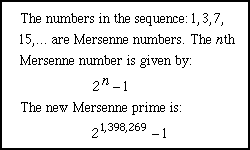
    About Mersenne numbers

    The new prime is a staggering 420,921 digits long. That's enough to fill a 200 page novel. But despite its size it's still only the 35th one of its kind to be discovered. "Finding this new Mersenne prime was quite a thrill! Mersenne primes are very rare, there was only one chance in 35,000 that this Mersenne number would turn out to be prime," said Armengaud.

    Despite their rarity mathematicians think there are infinitely many such primes, though this is unproved. In fact, there are many Mersenne numbers smaller than the new prime that remain untested. The message is clear: you too could join the likes of Euler and go down in history as the person who discovered a Mersenne prime.

    For more information about GIMPS see http://www.mersenne.org/prime.htm.

    Read more about...
    computer search
    prime number
    GIMPS
    Mersenne prime
    • Log in or register to post comments

    Read more about...

    computer search
    prime number
    GIMPS
    Mersenne prime
    University of Cambridge logo

    Plus is part of the family of activities in the Millennium Mathematics Project.
    Copyright © 1997 - 2025. University of Cambridge. All rights reserved.

    Terms