Maths at the British Science Festival 2012
The British Science Festival comes to Aberdeen this year from 4th to 9th September. It's the largest annual public science event in Europe. This year's theme is Energising minds — and there's plenty of maths on offer to energise yours. The maths events in this year's main programme are:
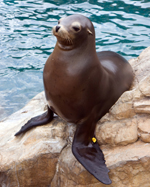
Stats explores the interaction between seals and cod.
- Fishy figures — How do statistical methods improve our understanding of the sea and how we use it? How do these methods improve our knowledge of the numbers of whales, the protection of humans from shellfish toxins, and the interaction between cod and seals? Find out how statistics are used to understand the world around us.
Wednesday 5 September, 13:00–15:00
Audience level: everyone
Price: free
Book here - Expanding minds and universes: Presidential Lecture by John D. Barrow — Join John D. Barrow to hear about how Einstein made it possible for cosmologists to study whole universes. Find out how expanding universes, rotating universes, chaotic universes, inflationary universes, accelerating universes and multiverses were all discovered. What is the current best description of the Universe and what problems still remain to be solved by mathematical physicists? Followed by a wine reception 16:30–17:30 sponsored by the Edinburgh Mathematical Society.
Friday 7 September 15:30–16:30
Audience level: all adults
Price: free
Book here - In tune with mathematics — What does it mean to be musically 'in tune'? The story takes us from Pythagoras to the modern day. We'll see why the standard Western tuning of instruments is in fact out of tune and we'll see how mathematics revolutionised the music industry via software that helps singers sing in tune. Along the way we hope to solve the puzzle of the Beatles' Magical Mystery Chord.
Saturday 8 September 15:00–17:00
Audience level: everyone
Price: free
Book here - Turing: the human vs the machine — Alan Turing, one of the truly original thinkers of the last century, was born in 1912. We celebrate his centenary with an overview of his achievements in logic, mathematics, computing and artificial intelligence. The Turing test asks whether you can distinguish, blindfolded, a human's conversation from a computer's. Join in and cast your vote.
Sunday 9 September 15:30–17:30
Audience level: everyone
Price: free
Book here - The maths and computing magic show — Witness some amazing magic tricks and sneak behind the scenes to explore the maths and computing secrets behind them. Mathematics and computer science are behind today's technological wizardry, and help us understand our own brains! Peter McOwan and Matt Parker are both scientists and magicians, and they will be your guides to the secret world where science and conjuring meet.
Sunday 9 September 18:00–20:00
Audience level: families
Price: £5
Book here
And there's much more interesting stuff besides. To find out, have a look at the programme.