
Maths in a minute: Differential equations
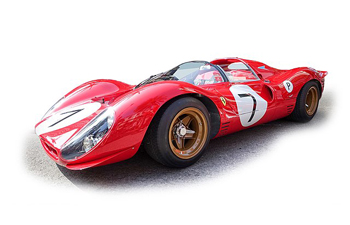
This Ferrari 330 P4 probably does more than 70mph. Image: Marti B, CC BY-SA 2.0.
Imagine you are driving down the motorway at a steady speed of 70mph. If you arrive at your destination in 2 hours, then you'll easily work out that you have travelled a distance of 140 miles. What you have done here, without noticing, is solve a differential equation. Speed is the rate of change of distance over time. From observing this rate of change you have worked out the value of the quantity that has been changing, namely distance, at the end of your journey.
This, put simply, is what differential equations are about. When we look at the world around us, often what we see, and what we can measure, is change: how some quantity $y$ changes over time, or space, or with respect to some other quantity $x$. We can describe this change by an equation: that's what is called an ordinary differential equation. In our car example, $y$ was distance and $x$ was time. Writing $\frac{dy}{dx}$ for the rate of change, the corresponding ordinary differential equation is $$\frac{dy}{dx}=70.$$ Solving the differential equation amounts to working out, from the rate of change of $y$ with respect to $x$, the value of $y$ for every value of $x$. In the car example the solution to the ordinary differential equation is $$y(x) = 70x.$$ For $x=2$, so after a travelling time 2 hours, the distance travelled is $$y(2)=70 \times 2=140,$$ as we said before.
Now speed is the rate of change of distance over time: it is what is called the first derivative of distance with respect to time. Acceleration is the rate of change of speed over time, which makes it the second derivative of distance with respect to time. You can continue like this. The rate of change of acceleration over time would be the third derivative of distance with respect to time, and so on, giving you a whole sequence of higher order derivatives. An ordinary differential equation is an equation involving a quantity $y$ and its higher order derivatives with respect to a quantity $x$.
But we are not quite done yet. You could also have equations relating the rates of change of a quantity $y$ with respect to several other quantities. For example, if you are considering how a quantity $y$ changes as you move around in space, you might need to consider its rate of change with respect to all three directions of space. In terms of vertigo, for example, the rate of change will be very different if you go up than if you move left or right or forward or backward. When this happens you need to use partial derivatives of $y$ with respect to any of the quantities it depends on. An equation involving these partial derivatives (of all orders) is called a partial differential equation.
There are countless uses for differential equations in all areas of maths and science. For a wide range of examples, see this collection of Plus articles. For more formal definitions of differential equations, have a look at Wikipedia.
This article now forms part of our collaboration with the Isaac Newton Institute for Mathematical Sciences (INI) – you can find all the content from our collaboration here. The INI is an international research centre and our neighbour here on the University of Cambridge's maths campus. It attracts leading mathematical scientists from all over the world, and is open to all. Visit www.newton.ac.uk to find out more.
