
Home
plus.maths.org

Secondary menu

  • My list
  • About Plus
  • Sponsors
  • Subscribe
  • Contact Us
  • Log in
  • Main navigation

  • Home
  • Articles
  • Collections
  • Podcasts
  • Maths in a minute
  • Puzzles
  • Videos
  • Topics and tags
  • For

    • cat icon
      Curiosity
    • newspaper icon
      Media
    • graduation icon
      Education
    • briefcase icon
      Policy

    Popular topics and tags

    Shapes

    • Geometry
    • Vectors and matrices
    • Topology
    • Networks and graph theory
    • Fractals

    Numbers

    • Number theory
    • Arithmetic
    • Prime numbers
    • Fermat's last theorem
    • Cryptography

    Computing and information

    • Quantum computing
    • Complexity
    • Information theory
    • Artificial intelligence and machine learning
    • Algorithm

    Data and probability

    • Statistics
    • Probability and uncertainty
    • Randomness

    Abstract structures

    • Symmetry
    • Algebra and group theory
    • Vectors and matrices

    Physics

    • Fluid dynamics
    • Quantum physics
    • General relativity, gravity and black holes
    • Entropy and thermodynamics
    • String theory and quantum gravity

    Arts, humanities and sport

    • History and philosophy of mathematics
    • Art and Music
    • Language
    • Sport

    Logic, proof and strategy

    • Logic
    • Proof
    • Game theory

    Calculus and analysis

    • Differential equations
    • Calculus

    Towards applications

    • Mathematical modelling
    • Dynamical systems and Chaos

    Applications

    • Medicine and health
    • Epidemiology
    • Biology
    • Economics and finance
    • Engineering and architecture
    • Weather forecasting
    • Climate change

    Understanding of mathematics

    • Public understanding of mathematics
    • Education

    Get your maths quickly

    • Maths in a minute

    Main menu

  • Home
  • Articles
  • Collections
  • Podcasts
  • Maths in a minute
  • Puzzles
  • Videos
  • Topics and tags
  • Audiences

    • cat icon
      Curiosity
    • newspaper icon
      Media
    • graduation icon
      Education
    • briefcase icon
      Policy

    Secondary menu

  • My list
  • About Plus
  • Sponsors
  • Subscribe
  • Contact Us
  • Log in
  • News from the world of maths: What would you like to know about your Universe

    22 July, 2009
    Wednesday, July 22, 2009

    What would you like to know about your Universe — The fourth online poll
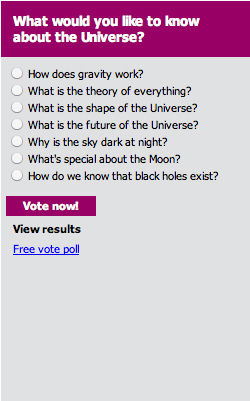
    This poll is now closed. The most popular question was: "How does gravity work?" You can read the answer on Plus, or listen to the podcast. Thank you for taking part and don't forget to vote in the current poll!

    This is the fourth online poll in our series to celebrate the International Year of Astronomy 2009. Choose your favourite question from the list on the right, and we'll put the one that proves most popular to world-leading astronomers and cosmologists, including Astronomer Royal Martin Rees and author and cosmologist John D. Barrow. The poll will remain open for a month and the answer will be published in a Plus article and podcast soon after. If your most burning question is not on this list, then leave a comment on this blog and we'll endeavour to include it in a future poll — there will be three more polls dotted throughout the year.

    The most popular questions in the first two polls were What happened before the Big Bang? and Are the constants of nature really constant?. Read the answers by clicking on the links, and discuss them on our blog. The third poll came up with the question "What are dark energy and dark matter?" and we will publish the answer on Plus shortly.

    Labels: IYA2009

    posted by Plus @ 1:22 PM

    1 Comments:

    At 9:43 PM, Anonymous Anonymous said...

    A topic that I would like covered are the different black holes and how they formed:
    - mega black hole
    - stella black hole
    - micro black hole
    - others ....

     
    • Log in or register to post comments
    University of Cambridge logo

    Plus is part of the family of activities in the Millennium Mathematics Project.
    Copyright © 1997 - 2025. University of Cambridge. All rights reserved.

    Terms