
Home
plus.maths.org

Secondary menu

  • My list
  • About Plus
  • Sponsors
  • Subscribe
  • Contact Us
  • Log in
  • Main navigation

  • Home
  • Articles
  • Collections
  • Podcasts
  • Maths in a minute
  • Puzzles
  • Videos
  • Topics and tags
  • For

    • cat icon
      Curiosity
    • newspaper icon
      Media
    • graduation icon
      Education
    • briefcase icon
      Policy

    Popular topics and tags

    Shapes

    • Geometry
    • Vectors and matrices
    • Topology
    • Networks and graph theory
    • Fractals

    Numbers

    • Number theory
    • Arithmetic
    • Prime numbers
    • Fermat's last theorem
    • Cryptography

    Computing and information

    • Quantum computing
    • Complexity
    • Information theory
    • Artificial intelligence and machine learning
    • Algorithm

    Data and probability

    • Statistics
    • Probability and uncertainty
    • Randomness

    Abstract structures

    • Symmetry
    • Algebra and group theory
    • Vectors and matrices

    Physics

    • Fluid dynamics
    • Quantum physics
    • General relativity, gravity and black holes
    • Entropy and thermodynamics
    • String theory and quantum gravity

    Arts, humanities and sport

    • History and philosophy of mathematics
    • Art and Music
    • Language
    • Sport

    Logic, proof and strategy

    • Logic
    • Proof
    • Game theory

    Calculus and analysis

    • Differential equations
    • Calculus

    Towards applications

    • Mathematical modelling
    • Dynamical systems and Chaos

    Applications

    • Medicine and health
    • Epidemiology
    • Biology
    • Economics and finance
    • Engineering and architecture
    • Weather forecasting
    • Climate change

    Understanding of mathematics

    • Public understanding of mathematics
    • Education

    Get your maths quickly

    • Maths in a minute

    Main menu

  • Home
  • Articles
  • Collections
  • Podcasts
  • Maths in a minute
  • Puzzles
  • Videos
  • Topics and tags
  • Audiences

    • cat icon
      Curiosity
    • newspaper icon
      Media
    • graduation icon
      Education
    • briefcase icon
      Policy

    Secondary menu

  • My list
  • About Plus
  • Sponsors
  • Subscribe
  • Contact Us
  • Log in
  • Tricky trig solution

    1 December, 2001
    Mar 2002

    We received quite a few correct solutions for this month's puzzle. In case it defeated you, the key was to look for symmetries in the information you are given, and to use similar triangles.

    Part I
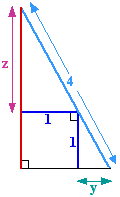
    With $y$ and $z$ as in the diagram, $x=z+1$, so it is sufficient to find $z$. By similar triangles, $z:1$ as $1:y$, so $zy=1.$

    By Pythagoras' Theorem, \begin{eqnarray*} (z+1)^2 + (y+1)^2 &= 16,\\ z^2 + 2z + 1 + y^2 +2y +1 &= 16,\\ (z+y)^2 - 2zy + 2z + 2y + 2 &= 16. \end{eqnarray*} But $zy=1$, so $$(z+y)^2 + 2(z + y) - 16 =0.$$ Solving this equation for $z+y$, and taking only the positive solution, yields $$z+y = \sqrt{17}-1.$$ Now we find $z-y$. $$ (z+y)^2 - (z-y)^2 = 4zy = 4,$$ \begin{eqnarray*} (z-y)^2 &=& (z+y)^2 - 4\\ &=& (\sqrt{17}-1)^2 - 4\\ &=&17 -2\sqrt{17} + 1 - 4\\ &=& 14 - 2\sqrt{17}. \end{eqnarray*} So $$z+y = \sqrt{14 - 2\sqrt{17}}$$ and \begin{eqnarray*} 2z &=& (z+y) - (z-y)\\ &=& (\sqrt{17}-1) - (\sqrt{14 - 2\sqrt{17}}) \\ &=& 5.52. \end{eqnarray*} Therefore $$x = z+1 = 2.76 + 1 = 3.76.$$

    Part II
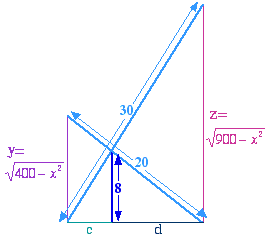
    There are a number of approaches to this problem, but the one presented here follows from the observation that the information given is left-right symmetric - in other words, finding the two vertical heights will be equally easy (or hard!). We will label these two heights $y$ and $z$, as in the diagram.
    By similar triangles, and dividing $x$ up into two segments $c$ and $d$, we see that $y:x$ as $8:d$ and $z:x$ as $8:c$; therefore $$z = 8x/c \mbox{ and} y=8x/d.$$ Adding gives $y+z = 8x^2/cd$ and multiplying gives $yz = 64x^2/cd.$ Combining these two results gives \begin{eqnarray*} yz &=& 8(y+z);\\ (y+z)/yz &=& 1/8;\\ 1/z + 1/y &=& 1/8. \end{eqnarray*} Leaving this equation to one side for a moment, we can use Pythagoras' Theorem to find each of $y$ and $z$ in terms of our unknown $x$, as shown in the diagram above. Combining these two expressions gives that $z^2 - y^2 = 500$.

    Using Pythagoras' Theorem, we draw a triangle to represent this relationship:
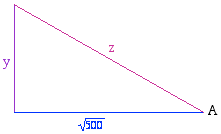
    On its own, the information in this diagram is not enough to solve the triangle - for that, we would need one more bit of information. But now we can use the identity $yz = 8(y+z).$ All we have to do is find some combination of trig functions of $A$ that takes the form $1/z + 1/y$. Since $cos(A) = \sqrt{500}/y$ and $tan(A) = y/\sqrt{500}$, it is easy to see that $$ cos(A) + 1/tan(A) = \sqrt{500}(1/z + 1/y) = \sqrt{500}/8 = 2.7951.$$ Using a calculator gives $A = 27^o38^{\prime}30^{\prime\prime}$ and $z= \sqrt{500}/cos A = 25.24$. Therefore $$x= \sqrt{900 - (25.24)^2} = 16.2.$$

    • Log in or register to post comments
    University of Cambridge logo

    Plus is part of the family of activities in the Millennium Mathematics Project.
    Copyright © 1997 - 2025. University of Cambridge. All rights reserved.

    Terms