
'Tribute to a mathemagician'
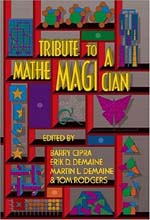
Tribute to a mathemagician
edited by Barry Cipra et al
"Tribute to a Mathemagician" is the third book in a series of publications based on the Gathering for Gardner meetings, a regular gathering of enthusiasts who share Martin Gardner's interests in mathematics, magic and puzzle creation. Martin Gardner, the father of recreational mathematics, has influenced readers all over the world with his "Mathematical Games" column in Scientific American, which ran for 25 years.
This carefully edited volume opens with a collection of articles to honour two recently deceased participants of the gathering: Edward Hordern and Nobuyuki Yoshigahra. The reminder of the book is an assortment of over 30 different contributions, ranging from one-page expositions to full-length articles, by the most influential and best-known mathemagicians in the world of puzzles.
The puzzles are organised in seven parts: Braintreasures, Brainticklers, Brainteasers, Braintemplers, Braintaunters and Braintools. Each section contains a variety of challenges, which vary in difficulty and level of sophistication ensuring that everyone will find something to tempt them to pick up pencil and paper and attempt to puzzle it out. As well as read articles on the history of puzzles such as the Chinese Ceramic Puzzle Vessels, the reader can investigate paper folding games, find out how to build a three-legged hourglass that lets us measure fractions of the total time, design puzzles with a computer, think about Polyomino Number Theory and learn about Gödelian Puzzles.
The contributions vary in style from author to author, but they all share an admiration and recognition for Martin Gardner's work, and a sense of community which is very engaging and inspiring.
Most of the articles are entertaining and easy enough to follow, but you will also find some puzzles that are very hard to solve. But mathematicians, magicians, and puzzlists are all masters of the unsolvable, and have inspired and enlightened countless generations by unmasking the art of paradox. So there is something in the book for mathematicians from secondary school level and up, and, whether you are looking for some mental challenge or simply would like to learn about paradoxes and puzzles, this book will be a welcome addition to your library.
- Book details:
- Tribute to a mathemagician
- edited by Barry Cipra, Erik D. Demaine, Martin L. Demaine and Tom Rodgers
- hardback - 350 pages (2004)
- A K Peters
- ISBN: 1568812043
Cristina Escoda is a final year Phd student at the University of Cambridge working on the phenomenology of String Theory and Supersymmetry. She is an enthusiastic writer and very interested in science communication.