
Home
plus.maths.org

Secondary menu

  • My list
  • About Plus
  • Sponsors
  • Subscribe
  • Contact Us
  • Log in
  • Main navigation

  • Home
  • Articles
  • Collections
  • Podcasts
  • Maths in a minute
  • Puzzles
  • Videos
  • Topics and tags
  • For

    • cat icon
      Curiosity
    • newspaper icon
      Media
    • graduation icon
      Education
    • briefcase icon
      Policy

    Popular topics and tags

    Shapes

    • Geometry
    • Vectors and matrices
    • Topology
    • Networks and graph theory
    • Fractals

    Numbers

    • Number theory
    • Arithmetic
    • Prime numbers
    • Fermat's last theorem
    • Cryptography

    Computing and information

    • Quantum computing
    • Complexity
    • Information theory
    • Artificial intelligence and machine learning
    • Algorithm

    Data and probability

    • Statistics
    • Probability and uncertainty
    • Randomness

    Abstract structures

    • Symmetry
    • Algebra and group theory
    • Vectors and matrices

    Physics

    • Fluid dynamics
    • Quantum physics
    • General relativity, gravity and black holes
    • Entropy and thermodynamics
    • String theory and quantum gravity

    Arts, humanities and sport

    • History and philosophy of mathematics
    • Art and Music
    • Language
    • Sport

    Logic, proof and strategy

    • Logic
    • Proof
    • Game theory

    Calculus and analysis

    • Differential equations
    • Calculus

    Towards applications

    • Mathematical modelling
    • Dynamical systems and Chaos

    Applications

    • Medicine and health
    • Epidemiology
    • Biology
    • Economics and finance
    • Engineering and architecture
    • Weather forecasting
    • Climate change

    Understanding of mathematics

    • Public understanding of mathematics
    • Education

    Get your maths quickly

    • Maths in a minute

    Main menu

  • Home
  • Articles
  • Collections
  • Podcasts
  • Maths in a minute
  • Puzzles
  • Videos
  • Topics and tags
  • Audiences

    • cat icon
      Curiosity
    • newspaper icon
      Media
    • graduation icon
      Education
    • briefcase icon
      Policy

    Secondary menu

  • My list
  • About Plus
  • Sponsors
  • Subscribe
  • Contact Us
  • Log in
  • Red Napkin Ring

    Finding the volume of a tricky shape

    1 January, 1997
    January 1997


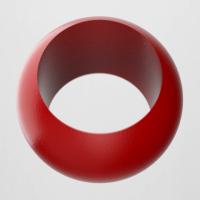
    The PASS Maths logo depicts a sphere 'pierce d' by a cylinder embossed with the words PASS Maths. Our first puzzle concerns just such a shape, here referred to as The Ring.
    Problem diagram

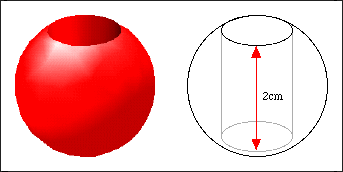
    A ring is made from a solid sphere by drilling out a cylindrical hole through the sphere's centre. The axis of the cylinder goes through the centre of the sphere. When the ring is stood on a flat surface, it is exactly 2cm high. The question is, what is the volume of the solid material of the ring in cubic centimeters? You are also told that you have enough information to solve this problem.

    We will publish the best solutions in the next issue, along with the answer to the problem itself.

    Solution


    • Log in or register to post comments

    Anonymous

    18 November 2013

    Permalink
    Comment

    Let R=sphere radius
    Let r=cylinder radius
    then sphere Cap height = R-1
    considering that V.Sphere.Cap= 1/3*PI*(Cap.Hight)^2*(3*R-Cap.Hight)
    => V.Sphere.Cap = 1/3*PI*(R-1)^2*(3R-(R-1))
    V.Sphere.Cap = 1/3*PI*(R^2-2R+1)(2R+1)
    V.Sphere.Cap = 1/3*PI*(2R^3-3R^2+1)

    V.Ring=Vol.Sphere -2*V.Sphere.Cape-V.cylender
    V.Ring=4/3*PI*R^3 - 2*(1/3*PI*(2R^3-3R^2+1)) - 2*PI*r^2
    but r^2=R^2 -1^2=R^2-1
    substitute on above we get
    V.Ring=4/3*PI*R^3 - 2*(1/3*PI*(2R^3-3R^2+1)) - 2*PI*R^2 + 2*PI
    V.Ring=4/3*PI*R^3 - 4/3*PI*R^3 + 2*PI*R^2 -2/3*PI - 2*PI*R^2 + 2*PI
    V.Ring= -2/3*PI + 2*PI
    V.Ring= 4/3 *PI

    • Log in or register to post comments

    Anonymous

    29 November 2013

    Permalink
    Comment

    I first saw his puzzle over 25 years ago when it concerned a mouse eating his way through a ball of cheese. I remember the date as I put the puzzle to my then future wife on St Valentine's day over a romantic(!) dinner date. Bemused, she allowed me to solve it on my napkin using integral of pi y squared dx.

    But leaving that aside. Since you're not told of the diameter of the hole it can make no difference, so take the diameter as 0. You then have a sphere of radius 1cm whose volume will be 4/3 pi r cubed, (4.pi)/3.

    As I said to her at the time: QED

    Roy Lambert

    • Log in or register to post comments

    Read more about...

    puzzle
    volume of sphere
    University of Cambridge logo

    Plus is part of the family of activities in the Millennium Mathematics Project.
    Copyright © 1997 - 2025. University of Cambridge. All rights reserved.

    Terms