
Planets, planets everywhere
Up until the late 1990s, astronomers couldn't be certain that any planets existed outside our solar system.
These days, not only are astronomers confident that planets are out there, but new ones are being discovered all the time. Even more importantly, a number of methods are being used to find them.
Spot the wobble
In September 1999, astronomers confirmed the existence of an extrasolar planet by measuring for the first time the way it caused its parent star to wobble.
The parent star, Upsilon Andromedae, is a star much like our own sun and about 45 light years away. It is now known to have at least three planets orbiting it, and the motion of the outermost planet has been detected by the Hipparcos satellite.
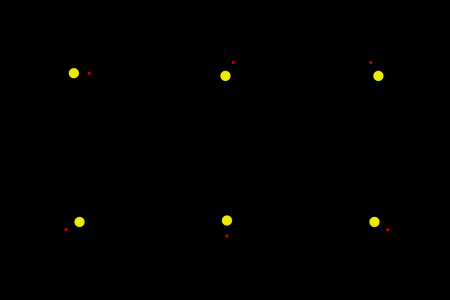
A wobbling star
A star and its orbiting planet will share a mutual gravitational attraction. This not only keeps the planet circling around the star, but it also causes the star itself to "wobble" slightly as the planet moves around it.
The spectrum of light we see from a given star is affected by how fast it is moving towards or away from us. A slight wobble in the star's motion will cause an equivalent wobble in the spectrum of light that we see from the star.
The Hipparcos satellite, launched in 1989, is sensitive enough to detect such subtle changes. It can thus be used to confirm the existence of planets orbiting distant stars.
Hipparcos's observations have allowed us to measure approximately the mass of the outermost planet of Upsilon Andromedae. We now know that it has around 10 times the mass of our own planet Jupiter, with an uncertainty of about 5 Jupiter masses. This mass measurement confirms that the object really is a planet, rather than a small companion star that didn't get quite big enough to shine.
A distant eclipse
In another breakthrough, astronomers have recently confirmed the existence of another planet by watching a "solar eclipse".
When an orbiting planet passes between us and its parent star, it causes the observed brightness of the star to dim slightly. This is simply because the planet is "in the way" - blocking our view of the star.
Professor Geoffrey Marcy from the University of California, Berkeley, already suspected the existence of a planet orbiting a star called HD 209458 because the star appeared to "wobble" like Upsilon Andromedae.
On 7 November 1999, Professor Greg Henry from Tennessee State University confirmed this prediction. He observed a 1.7% dimming in brightness of the star at just the the time when Marcy and his colleagues predicted the planet would cross the star's face.
"This planetary transit occurred at exactly the time predicted from Marcy's observations, confirming absolutely the presence of a companion," said Professor Henry.
The star HD 209458 is only 150 light years from Earth, and calculations suggest that its planet has a mass around 63% of Jupiter's, but a radius around 60% larger. This fits well with current theories that planets like this, that are orbiting very close to their parent stars, will be "bloated".
- Transit of a planet
- Illustration and links about the transit from Geoffrey Marcy.
Shining example
In yet another new development, astronomers at St Andrew's University in Scotland and the Central Research Laboratories in England have detected light from the surface of an extrasolar planet.
A team of researchers, including Dr Andrew Collier-Cameron, Professor Keith Horne, Dr David James and Dr Alan Penny, has used mathematical techniques to hone in on the light reflected by a planet orbiting the star tau Bootes, about 50 light years from Earth.
The team knew that the planet existed because tau Bootes, like Upsilon Andromedae and HD 209458, had been observed to wobble. They also knew that the planet was slightly bigger than Jupiter: about 1.8 times Jupiter's size and 8 times Jupiter's mass. However, they had a novel idea for re-affirming the planet's existence.
The team knew that the planet orbited the star every 3.3 days. They used the Herschel Telescope to obtain a detailed series of observations of the spectra of light coming from the star and reflected from its planet.
Now, the spectra of light received from both the star and the planet are shifted according to whether each is moving towards or away from us.
During one part of the orbit the star is moving away from Earth and the planet is moving towards it. During the other part of the orbit the star is moving towards Earth and the planet is moving away from it.
These opposite shifts in the spectra of light from the star and planet enabled the team to write a computer program which could filter out the spectrum contributed by the planet.
"The eureka moment came in May, once most of this year's observations were complete," said Dr Collier-Cameron. "At that stage, as now, we were 95% certain that we had something."
While more observations are needed, the team are now confident that the planet orbiting tau Bootes has a blue-green colour. They are also hoping to try their method on other suspected extrasolar planets.
"This is a tremendous coup for British astronomers" said Ian Halliday, head of the Particle Physics and Astronomy Research Council.
"This discovery was made possible by the innovative work of British scientists," said Lord Sainsbury, the UK Minister for Science.
"It is exciting to be able to look, for the first time, at the light from a planet outside our own Solar System. It is another step in the search for life elsewhere in the Universe."