
Gold for Goldbach
In Issue 2 of Plus, we introduced you to Goldbach's Conjecture, the speculation by mathematician Christian Goldbach in a 1742 letter to Leonhard Euler that every even integer greater than 2 can be expressed as the sum of two (not necessarily different) prime numbers. (An alternative way of expressing this is that every even integer greater than 4 can be expressed as the sum of two odd primes).
To give Euler some credit, in fact in his letter Goldbach expressed the belief that "Every integer n > 5 is the sum of three primes". It was Euler who pointed out that this is easily seen to be equivalent to the statement that "Every even integer 2n >= 4 is the sum of two primes", the standard description of "Goldbach's Conjecture".
In 1998, Goldbach's Conjecture was shown by computer to be true for even numbers up to 400,000,000,000,000. In addition, some progress has been made towards formally proving the conjecture. In 1966 Chen proved that every sufficiently large even integer is the sum of a prime plus a number with no more than two prime factors. In 1995, Ramaré proved that every even integer is the sum of at most six primes. However, despite these and other efforts, nobody has yet come up with a full proof that Goldbach's Conjecture holds for all even numbers other than 2 (i.e. up to infinity).
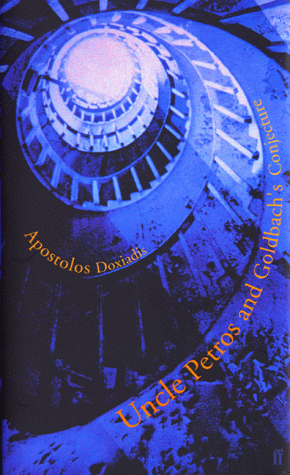
As of this year, mathematicians with Goldbach fever have some extra incentive for their labours. The famous publishing house Faber and Faber are offering a prize of one million dollars to anyone who can prove Goldbach's Conjecture in the next two years, as long as the proof is published by a respectable mathematical journal within another two years and is approved correct by Faber's panel of experts.
Faber have spent a five-figure sum insuring themselves in case they need to pay out. What's the motivation behind this vast prize? Faber have just published a new book by Greek mathematician and author Apostolos Doxiadis, called "Uncle Petros and Goldbach's Conjecture".
The book tells the story of a man who dedicates his life to the search for a proof of Goldbach's Conjecture, and has already been translated into 15 languages. Given the recent success of books describing great scientific quests, such as Dava Sobel's "Longitude" and Simon Singh's "Fermat's Last Theorem", Faber have high hopes of Doxiadis's book being a bestseller. Offering the prize will bring extra publicity and, Faber hope, extra sales.
"Now that we are insured", says Tony Faber, "I'd love it if someone won." How likely is this to happen? Alan Baker, a Professor at Cambridge University and a Fields Medallist, is not too hopeful. "[Chen's 1966 proof] is the best result so far, and it is unlikely that we will get any further without a big breakthrough. Unfortunately there is no such big idea on the horizon. But if we get that big idea, then we have something to build on. I don't think the money makes much difference. If people do it, they will do it for the challenge."
On the other hand, Professor Ian Stewart of Warwick University, Britain's best known popular writer and speaker on mathematics, is a little more optimistic. "I think some mathematicians will be dazzled by a million dollars. It might just tilt the balance."
Further fun
- Prime Puzzles
- A source of other interesting prime-related puzzles and conjectures.