
'Taking Chances'
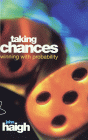
Taking Chances
by John Haigh
Reviewed by Helen Joyce (Plus editorial team)
Misunderstanding of probability may be the greatest of all impediments to scientific literacy
Stephen Jay Gould
John Haigh takes the above quote as the epigraph for "Taking Chances", and makes his own significant contribution to scientific literacy. He concerns himself with "games of chance" in the broadest sense, from the National Lottery, quiz shows, casino games and card, dice and coin games, through game-theoretic "games" such as military conflicts, to all types of sports.
The book is not an academic study of probability theory, but rather a trawl through many familiar situations where a probabilistic way of thinking can be used to great effect. The importance of such appealing subject matter should not be underestimated - probability theory cannot help being interesting when applied to such popular and familiar topics as the National Lottery and Countdown! Heavier maths is relegated to "boxes" and appendices, which may be ignored by the reader uninterested in technical details.
Writing in a comfortable, friendly style with entertaining anecdotes and plenty of humour, John Haigh makes the most of the fun to be had spotting the flaws in flawed arguments. Tongue in cheek, he presents some of the material as a type of "handbook for the unscrupulous". More seriously, he shows how to avoid the wrong end of loaded bets, and to make realistic decisions regarding chancy propositions.
There is plenty of commonsense analysis of the choices people really make, and everyday psychology such as the inability of human beings to make truly random choices. The importance of the context of a game is never forgotten, with material on the best strategies for playing casino games for fun, accepting the loss as the price for that enjoyment, and on deciding whether to play the pools, buy Premium Bonds, or enter the National Lottery, by considering either the average return or the chance of winning a life-changing sum.
There is a comparison of the scoring methods of many popular sports, such as snooker and tennis, with an analysis of the implications of different methods for opponents of different relative strengths. Probability theory is used to find the chance that your soccer team will win given that they scored the first goal, and to decide when a professional foul is worth it. You will also find how limited overs cricket matches are decided when rain stops play, and discover which point in tennis is the most important.
The analysis is always clear and the real-life examples always entertaining. Even if, like this reviewer, you care for none of sport, TV games or gambling, you are bound to be struck by the intricacies of tactics and the oddities highlighted by probabilistic analysis. If you want to start the study of probability in the right place, this is it.
- Book details:
- Taking Chances
- John Haigh
- paperback - 344 pages (2000)
- Oxford University Press
- ISBN: 0198502915