
'How long is a piece of string?'
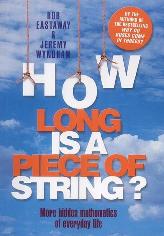
How long is a piece of string? More hidden mathematics of everyday life
This book is by the same authors as "Why do buses come in threes?", which was reviewed in Issue 10 of Plus. Like its predecessor, it consists of entertaining and thoughtprovoking questions on topics not obviously related to maths, and a discussion of each. The authors say that "give us a topic that we care about, and we all become mathematicians", and set out to prove it.
They call the book a compilation of "everyday maths" and say that their main criterion for including something was that it kept them entertained in the pub! So the tone is very light, and although it would be suitable for a curious 12 year old, it should also be enjoyed by people of any age.
The chapter that gives the book its title is about fractals - a fractal piece of string would be infinitely long, because it would be wiggly at every scale. There are also discussions of packing problems (including how men arrange themselves at urinals!), scams such as the discredited pyramid scheme "Women empowering women" and harmony ("Why do karaoke singers sound so bad?"). The material on game show strategies and the way lifts are programmed is particularly entertaining, and you are unlikely to have met the latter before. If you read this book, then the next time you wait too long for a lift, you may have some idea why!
The book contains very few worked calculations, and no difficult or advanced maths. It is more about asking questions than about providing the answers. For example, in the chapter on the spread of epidemics, a point is reached where differential equations would be needed for a fuller discussion. The authors say, "The mathematics of differential equations is certainly not trivial, and there is a severe risk that any further discussion on this topic will lead to a rapid glazing-over of eyes", and then move on. The truth of this statement depends on whether or not the reader is one of the converted. If you love mathematics, you may be disappointed not to find out about more about these intriguing things called differential equations, but if this is the first book on maths you have ever looked into, you will probably be relieved. However, maths fans and foes like should find the chapter on proof - "How can I be sure?" - really useful.
If you're a regular Plus reader, you almost certainly fall into the first category, and will find this book very light reading. But nonetheless it is enjoyable - the choice of questions is excellent, the discussion entertaining, and you could without fear lend it to your mathsphobic friends who might, just might, learn the error of their ways.
- Book details:
- How long is a piece of string?
- Rob Eastaway and Jeremy Wyndham
- hardback - 192 pages (2002)
- Robson Books
- ISBN: 1861055056