
Home
plus.maths.org

Secondary menu

  • My list
  • About Plus
  • Sponsors
  • Subscribe
  • Contact Us
  • Log in
  • Main navigation

  • Home
  • Articles
  • Collections
  • Podcasts
  • Maths in a minute
  • Puzzles
  • Videos
  • Topics and tags
  • For

    • cat icon
      Curiosity
    • newspaper icon
      Media
    • graduation icon
      Education
    • briefcase icon
      Policy

    Popular topics and tags

    Shapes

    • Geometry
    • Vectors and matrices
    • Topology
    • Networks and graph theory
    • Fractals

    Numbers

    • Number theory
    • Arithmetic
    • Prime numbers
    • Fermat's last theorem
    • Cryptography

    Computing and information

    • Quantum computing
    • Complexity
    • Information theory
    • Artificial intelligence and machine learning
    • Algorithm

    Data and probability

    • Statistics
    • Probability and uncertainty
    • Randomness

    Abstract structures

    • Symmetry
    • Algebra and group theory
    • Vectors and matrices

    Physics

    • Fluid dynamics
    • Quantum physics
    • General relativity, gravity and black holes
    • Entropy and thermodynamics
    • String theory and quantum gravity

    Arts, humanities and sport

    • History and philosophy of mathematics
    • Art and Music
    • Language
    • Sport

    Logic, proof and strategy

    • Logic
    • Proof
    • Game theory

    Calculus and analysis

    • Differential equations
    • Calculus

    Towards applications

    • Mathematical modelling
    • Dynamical systems and Chaos

    Applications

    • Medicine and health
    • Epidemiology
    • Biology
    • Economics and finance
    • Engineering and architecture
    • Weather forecasting
    • Climate change

    Understanding of mathematics

    • Public understanding of mathematics
    • Education

    Get your maths quickly

    • Maths in a minute

    Main menu

  • Home
  • Articles
  • Collections
  • Podcasts
  • Maths in a minute
  • Puzzles
  • Videos
  • Topics and tags
  • Audiences

    • cat icon
      Curiosity
    • newspaper icon
      Media
    • graduation icon
      Education
    • briefcase icon
      Policy

    Secondary menu

  • My list
  • About Plus
  • Sponsors
  • Subscribe
  • Contact Us
  • Log in
  • Rolling with money solution

    1 September, 2003
    September 2003

    Rolling with money

    Sue was fiddling wth two 10p coins, rolling one of them round the other. Martin came over. "You see these two identical coins?" said Sue. "I am going to keep the one on the right still while I roll the one on the left round it without it slipping or sliding. What do you think will happen to the Queen's head when it gets to the other side?"
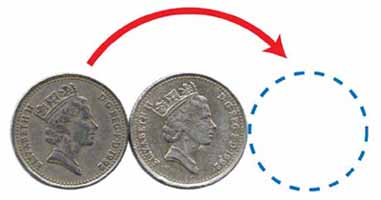
    two coins

    The starting position of the coins

    "The head will be upside down, of course!" Martin replied. Sue smiled smugly.

    What is the correct answer?

    The solution

    We received quite a few correct answers to this puzzle - and a few incorrect ones too. Readers took a number of different approaches, some more mathematical than others - one reader took the pragmatic approach and tried it out with two real coins!

    The correct answer is, of course, that the Queen's head is still right way up. The simplest way to see this is to look at the point of contact between the two coins. Since the coin on the left is moved around the one on the right without slipping or sliding, when the manoeuvre is finished, the contact point on each coin will have moved exactly the same distance on both coins. Since it moves around exactly half the circumference on the stationary coin, it must move around exactly half the circumference on the moving coin too - in other words, the coins end up as in the picture below, and the head must be right way up again.
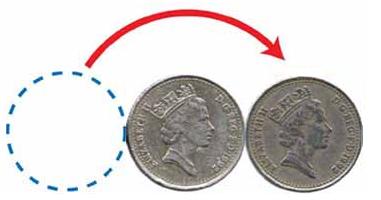
    two coins

    The final position of the coins


    Back to main puzzle page
    • Log in or register to post comments

    Anonymous

    8 April 2012

    Permalink
    Comment

    I've seen this in terms of rolling one coin completely around another...it will rotate TWICE
    Reason: one circumference's worth will rotate it once, however this 'path' is not flat and is a circular path (ie the static coin) hence the second rotation

    • Log in or register to post comments
    University of Cambridge logo

    Plus is part of the family of activities in the Millennium Mathematics Project.
    Copyright © 1997 - 2025. University of Cambridge. All rights reserved.

    Terms