
Home
plus.maths.org

Secondary menu

  • My list
  • About Plus
  • Sponsors
  • Subscribe
  • Contact Us
  • Log in
  • Main navigation

  • Home
  • Articles
  • Collections
  • Podcasts
  • Maths in a minute
  • Puzzles
  • Videos
  • Topics and tags
  • For

    • cat icon
      Curiosity
    • newspaper icon
      Media
    • graduation icon
      Education
    • briefcase icon
      Policy

    Popular topics and tags

    Shapes

    • Geometry
    • Vectors and matrices
    • Topology
    • Networks and graph theory
    • Fractals

    Numbers

    • Number theory
    • Arithmetic
    • Prime numbers
    • Fermat's last theorem
    • Cryptography

    Computing and information

    • Quantum computing
    • Complexity
    • Information theory
    • Artificial intelligence and machine learning
    • Algorithm

    Data and probability

    • Statistics
    • Probability and uncertainty
    • Randomness

    Abstract structures

    • Symmetry
    • Algebra and group theory
    • Vectors and matrices

    Physics

    • Fluid dynamics
    • Quantum physics
    • General relativity, gravity and black holes
    • Entropy and thermodynamics
    • String theory and quantum gravity

    Arts, humanities and sport

    • History and philosophy of mathematics
    • Art and Music
    • Language
    • Sport

    Logic, proof and strategy

    • Logic
    • Proof
    • Game theory

    Calculus and analysis

    • Differential equations
    • Calculus

    Towards applications

    • Mathematical modelling
    • Dynamical systems and Chaos

    Applications

    • Medicine and health
    • Epidemiology
    • Biology
    • Economics and finance
    • Engineering and architecture
    • Weather forecasting
    • Climate change

    Understanding of mathematics

    • Public understanding of mathematics
    • Education

    Get your maths quickly

    • Maths in a minute

    Main menu

  • Home
  • Articles
  • Collections
  • Podcasts
  • Maths in a minute
  • Puzzles
  • Videos
  • Topics and tags
  • Audiences

    • cat icon
      Curiosity
    • newspaper icon
      Media
    • graduation icon
      Education
    • briefcase icon
      Policy

    Secondary menu

  • My list
  • About Plus
  • Sponsors
  • Subscribe
  • Contact Us
  • Log in
  • Mixing it up

    1 November, 2003
    November 2003
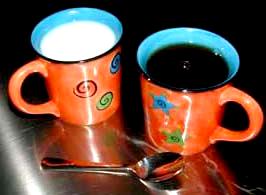
    cups of tea and milk


    I start with two full mugs, one containing milk and the other containing tea, in exactly equal amounts. I transfer 3 spoonsful of milk from the first mug to the second, and stir thoroughly. Then I transfer 3 spoonsful from the now-milky tea in the second mug back into the first mug.

    Which is greater: the amount of tea now in the first mug or the amount of milk now in the second mug?
     

    The solution

    This has to have been the most popular Plus puzzle ever! Lots of readers sent in solutions, some using logic, some algebra, many right, some wrong.

    The right answer is perhaps a little unintuitive - the amount of tea now in the first mug is exactly equal to the amount of milk now in the second mug!.

    To see this, you could use a bit of algebra, expressing the amount of milk and tea in each cup in teaspoonsful and then adding and subtracting 3's. You'll get the right answer, but it's easier if you think about it this way:

    Write V for the initial total volume in each mug. At the end, each mug still has a total volume V. Write W for the volume of milk in the second mug at the end (this means there is V-W of tea). By conservation of milk, since there was V to start with, there must be V-W of milk in the first mug and hence W of tea. So there is exactly the same amount of tea in the first mug as milk in the second.


    Back to main puzzle page
    • Log in or register to post comments

    Anonymous

    26 November 2011

    Permalink
    Comment

    What bout the dilution of the tea with milk?

    • Log in or register to post comments

    Anonymous

    18 October 2013

    In reply to Doubt.... by Anonymous

    Permalink
    Comment

    if you took 30ml out of a 60 ml milk thing and added it to the tea you would have 2/3 tea 1/3 milk so when you take 30ml from the tea you would take 20ml tea and 10ml milk meaning you would have 20ml milk remaining and 20ml tea and 10ml of the original milk in to the milk so basically you only add 20ml to each.

    • Log in or register to post comments

    Anonymous

    10 February 2014

    In reply to if you took 30ml out of a 60 by Anonymous

    Permalink
    Comment

    is this talking about the volume of each mug or just tea ?

    • Log in or register to post comments

    Anonymous

    7 May 2016

    Permalink
    Comment

    If you imagine each mug to be filled with 100 balls representing droplets, then it is easier. If you take, let's say 25 droplets of tea into the milk, you have in one mug, 75 drops of tea and in the other 100 drops of milk and 25 drops of tea. Then, take 25 drops back, (staying equal to 25 drops, of course) let's say 5 drops of tea and 20 drops of milk. You then have 80 drops of tea and 20 drops of milk in one mug, and 80 drops of milk and 20 drops of tea in the other.

    • Log in or register to post comments
    University of Cambridge logo

    Plus is part of the family of activities in the Millennium Mathematics Project.
    Copyright © 1997 - 2025. University of Cambridge. All rights reserved.

    Terms