

Home
plus.maths.org

Secondary menu

  • My list
  • About Plus
  • Sponsors
  • Subscribe
  • Contact Us
  • Log in
  • Main navigation

  • Home
  • Articles
  • Collections
  • Podcasts
  • Maths in a minute
  • Puzzles
  • Videos
  • Topics and tags
  • For

    • cat icon
      Curiosity
    • newspaper icon
      Media
    • graduation icon
      Education
    • briefcase icon
      Policy

    Popular topics and tags

    Shapes

    • Geometry
    • Vectors and matrices
    • Topology
    • Networks and graph theory
    • Fractals

    Numbers

    • Number theory
    • Arithmetic
    • Prime numbers
    • Fermat's last theorem
    • Cryptography

    Computing and information

    • Quantum computing
    • Complexity
    • Information theory
    • Artificial intelligence and machine learning
    • Algorithm

    Data and probability

    • Statistics
    • Probability and uncertainty
    • Randomness

    Abstract structures

    • Symmetry
    • Algebra and group theory
    • Vectors and matrices

    Physics

    • Fluid dynamics
    • Quantum physics
    • General relativity, gravity and black holes
    • Entropy and thermodynamics
    • String theory and quantum gravity

    Arts, humanities and sport

    • History and philosophy of mathematics
    • Art and Music
    • Language
    • Sport

    Logic, proof and strategy

    • Logic
    • Proof
    • Game theory

    Calculus and analysis

    • Differential equations
    • Calculus

    Towards applications

    • Mathematical modelling
    • Dynamical systems and Chaos

    Applications

    • Medicine and health
    • Epidemiology
    • Biology
    • Economics and finance
    • Engineering and architecture
    • Weather forecasting
    • Climate change

    Understanding of mathematics

    • Public understanding of mathematics
    • Education

    Get your maths quickly

    • Maths in a minute

    Main menu

  • Home
  • Articles
  • Collections
  • Podcasts
  • Maths in a minute
  • Puzzles
  • Videos
  • Topics and tags
  • Audiences

    • cat icon
      Curiosity
    • newspaper icon
      Media
    • graduation icon
      Education
    • briefcase icon
      Policy

    Secondary menu

  • My list
  • About Plus
  • Sponsors
  • Subscribe
  • Contact Us
  • Log in
  • Colourful Gun Graffiti

    Russian roulette

    1 March, 2009
    March 2009
    Revolver


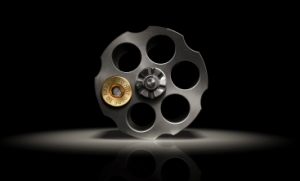
    Your mother did tell you to stay away from gambling, but now it's far, far too late to head her advice. You're sitting in a smoke-filled room, your single opponent staring you down. Between you, on a table, there is six-shot revolver, containing exactly one live bullet. Someone has spun the cylinder so neither of you knows whether the next shot will be blank or lethal. Each of you will take one shot at the opponent in turn, and the cylinder will be spun again after each shot. The game ends, obviously, when one of you fires the lethal shot, and the other person is dead. It's your choice whether to go first or second — which should you choose? Does it matter?

    This puzzle was inspired by a problem in the book Number Story, which is reviewed in this issue of Plus.


    If you are stumped by last issue's puzzle, here is the solution.

    For some challenging mathematical puzzles, see the NRICH puzzles from this month or last month.

    Solution link
    Russian roulette solution
    • Log in or register to post comments

    Anonymous

    3 April 2012

    Permalink
    Comment

    Go for the first shot.
    In the second worst case you get to fire 3 shots first and you have more opportunity..

    --Arun B

    • Log in or register to post comments

    Anonymous

    19 May 2012

    Permalink
    Comment

    Surely it's best to go second! Whether you go first, second, third, fourth, etc, when the gun is in your hand, the chance of the shot being a killer is exactly the same. But...

    During the first go, the shooter has a 1/6 chance of dying but the opponent (the second shooter), who doesn't have the gun, has a 0 chance of dying.. because they don't have the gun! Therefore your chance of survival is massively greater if you go second!

    • Log in or register to post comments

    Tayler

    30 April 2019

    Permalink
    Comment

    The probability is reset every time you spin the barrel so it is a 1/6 chance every time you pull the trigger, so it doesn't matter which you choose.

    • Log in or register to post comments

    Esteban Aleman

    16 April 2020

    Permalink
    Comment

    Third, because in the second, it can give you the bullet in the head, and therefore, in the third, it cannot give you because when it shoots, it turns and when you reload, it turns again, that's why the third

    • Log in or register to post comments
    University of Cambridge logo

    Plus is part of the family of activities in the Millennium Mathematics Project.
    Copyright © 1997 - 2025. University of Cambridge. All rights reserved.

    Terms