
Home
plus.maths.org

Secondary menu

  • My list
  • About Plus
  • Sponsors
  • Subscribe
  • Contact Us
  • Log in
  • Main navigation

  • Home
  • Articles
  • Collections
  • Podcasts
  • Maths in a minute
  • Puzzles
  • Videos
  • Topics and tags
  • For

    • cat icon
      Curiosity
    • newspaper icon
      Media
    • graduation icon
      Education
    • briefcase icon
      Policy

    Popular topics and tags

    Shapes

    • Geometry
    • Vectors and matrices
    • Topology
    • Networks and graph theory
    • Fractals

    Numbers

    • Number theory
    • Arithmetic
    • Prime numbers
    • Fermat's last theorem
    • Cryptography

    Computing and information

    • Quantum computing
    • Complexity
    • Information theory
    • Artificial intelligence and machine learning
    • Algorithm

    Data and probability

    • Statistics
    • Probability and uncertainty
    • Randomness

    Abstract structures

    • Symmetry
    • Algebra and group theory
    • Vectors and matrices

    Physics

    • Fluid dynamics
    • Quantum physics
    • General relativity, gravity and black holes
    • Entropy and thermodynamics
    • String theory and quantum gravity

    Arts, humanities and sport

    • History and philosophy of mathematics
    • Art and Music
    • Language
    • Sport

    Logic, proof and strategy

    • Logic
    • Proof
    • Game theory

    Calculus and analysis

    • Differential equations
    • Calculus

    Towards applications

    • Mathematical modelling
    • Dynamical systems and Chaos

    Applications

    • Medicine and health
    • Epidemiology
    • Biology
    • Economics and finance
    • Engineering and architecture
    • Weather forecasting
    • Climate change

    Understanding of mathematics

    • Public understanding of mathematics
    • Education

    Get your maths quickly

    • Maths in a minute

    Main menu

  • Home
  • Articles
  • Collections
  • Podcasts
  • Maths in a minute
  • Puzzles
  • Videos
  • Topics and tags
  • Audiences

    • cat icon
      Curiosity
    • newspaper icon
      Media
    • graduation icon
      Education
    • briefcase icon
      Policy

    Secondary menu

  • My list
  • About Plus
  • Sponsors
  • Subscribe
  • Contact Us
  • Log in
  • Shaped by the wind

    by
    Rachel Thomas
    1 May, 2002
    May 2002

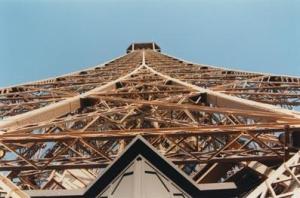
    When visitors to Paris admire the elegant tapering curves of the Eiffel Tower, they probably aren't aware that they are observing a triumph of mathematics over the forces of nature. The distinctive shape of the Tower, although beautiful, was actually designed mathematically by Eiffel to withstand the forces of the Parisian winds. Eiffel said of the tower, which stood as the world's tallest building for 41 years:

    "What phenomenon did I have to give primary concern in designing the Tower? It was wind resistance. Well, I hold that the curvature of the monument's four outer edges, which is as the mathematical calculations have dictated it should be, will give a great impression of strength and beauty."

    The mathematical calculations dictating the shape of the Tower have been examined in a recent article in the American Journal of Physics by Joseph Gallant.

    [IMAGE: The forces on the Eiffel Tower]

    The force of the wind (dF) produces a torque around the bottom left corner of the tower which is countered by the force of the Tower's weight (dW)

    By balancing the maximum torque generated by the wind with the torque generated by the Tower's own weight, Gallant has derived an equation which describes the shape of the Tower: $$ f(x)=xw(x)-\sqrt{x^2w^2(x)+f_0^2}, $$ where $f(x)$ is the half-width of the Tower at height $x$, $f_0$ is the half-width of the Tower at the ground and $w(x)$ is the maximum wind pressure the Tower can withstand at a height $x$. (This is a root of the quadratic equation describing a parabola resting against the right side of the Tower, so the curve of the Tower's right side is described by the negative arm of the parabola.)

    Eiffel, experienced in designing open lattice structures, allowed for a large safety margin by designing the Tower to withstand wind pressures of 4 kN/m2. The fastest winds recorded at the Tower reached a speed of 214 km/h in 1999 and would have produced pressures of just 2.28 kN/m2.

    The Eiffel Tower was built in 1889 for the Universal Exposition as a monument to the scientific achievements of the 19th century. And, thanks to the mathematical and engineering prowess of its designer Eiffel, it still stands as a witness to these scientific achievements over a century later.
    But is it stronger than me?!

    But is it stronger than me?!

    Read more about...
    torque
    wind resistance
    • Log in or register to post comments

    Comments

    Gerard

    9 June 2021

    Permalink

    You write "The Eiffel Tower was built in 1889 for the Universal Exposition as a monument to the scientific achievements of the 18th century." Shouldn't that be 19th Century - or perhaps 1800s?

    • Log in or register to post comments

    Rachel

    7 July 2021

    In reply to Maths by Gerard

    Permalink

    Thanks for spotting that mistake!

    • Log in or register to post comments

    Read more about...

    torque
    wind resistance
    University of Cambridge logo

    Plus is part of the family of activities in the Millennium Mathematics Project.
    Copyright © 1997 - 2025. University of Cambridge. All rights reserved.

    Terms